Roof Replacement Hampshire
Roof Replacement Services in Hampshire
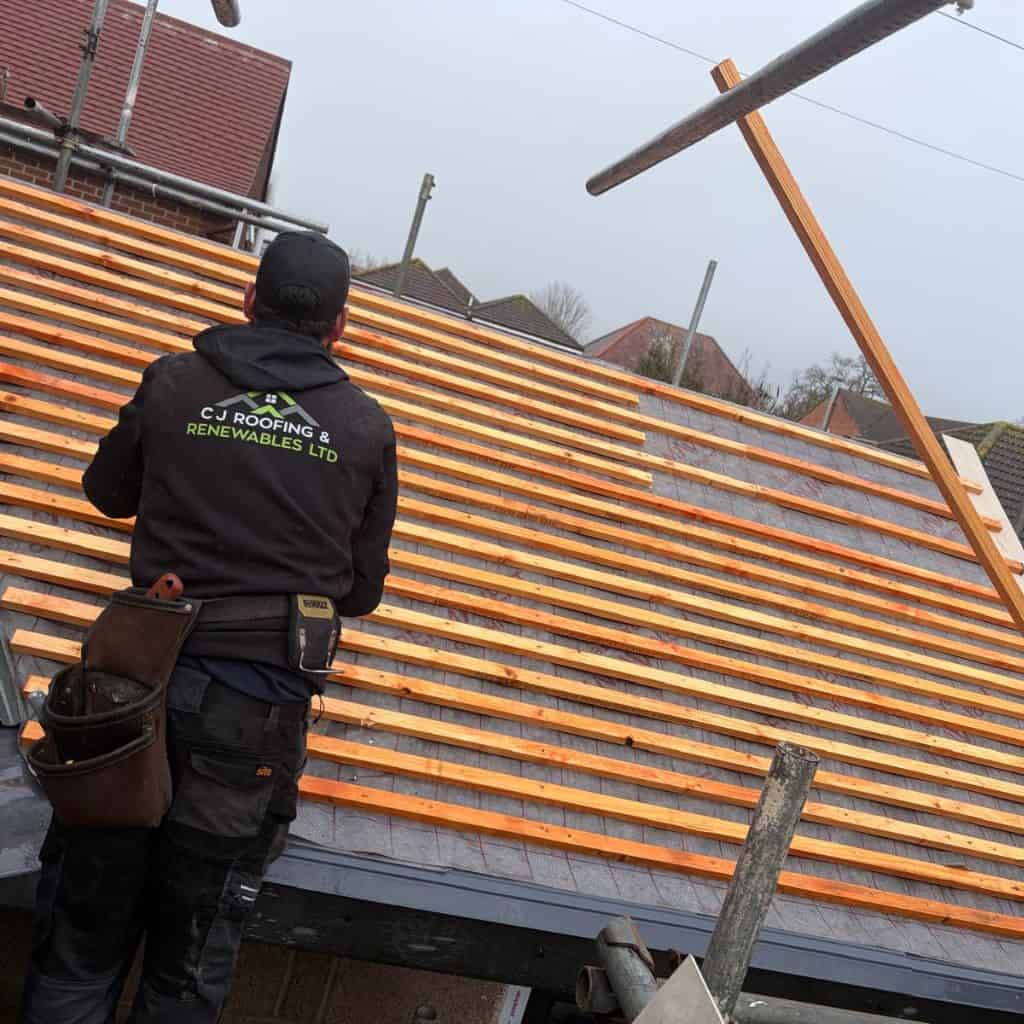
A full roof replacement resolves problems that repairs can no longer address: persistent leaks, rotting timbers, and a covering that has reached the end of its serviceable life. The work involves stripping the existing covering back to the rafters, checking the deck, and reconstructing the roof with new battens, underlay and tiles.
C J Roofing & Renewables Ltd specialises in roof replacements across Hampshire. We remove materials down to the rafters, install new battens and felt, and lay matching tiles. Every replacement carries a 10-year workmanship guarantee.
Your written, itemised quote follows within 48 hours of the survey. Call 07512976384 for a free quote. We respond within 48 hours.
How do you know your roof needs replacing rather than repairing?
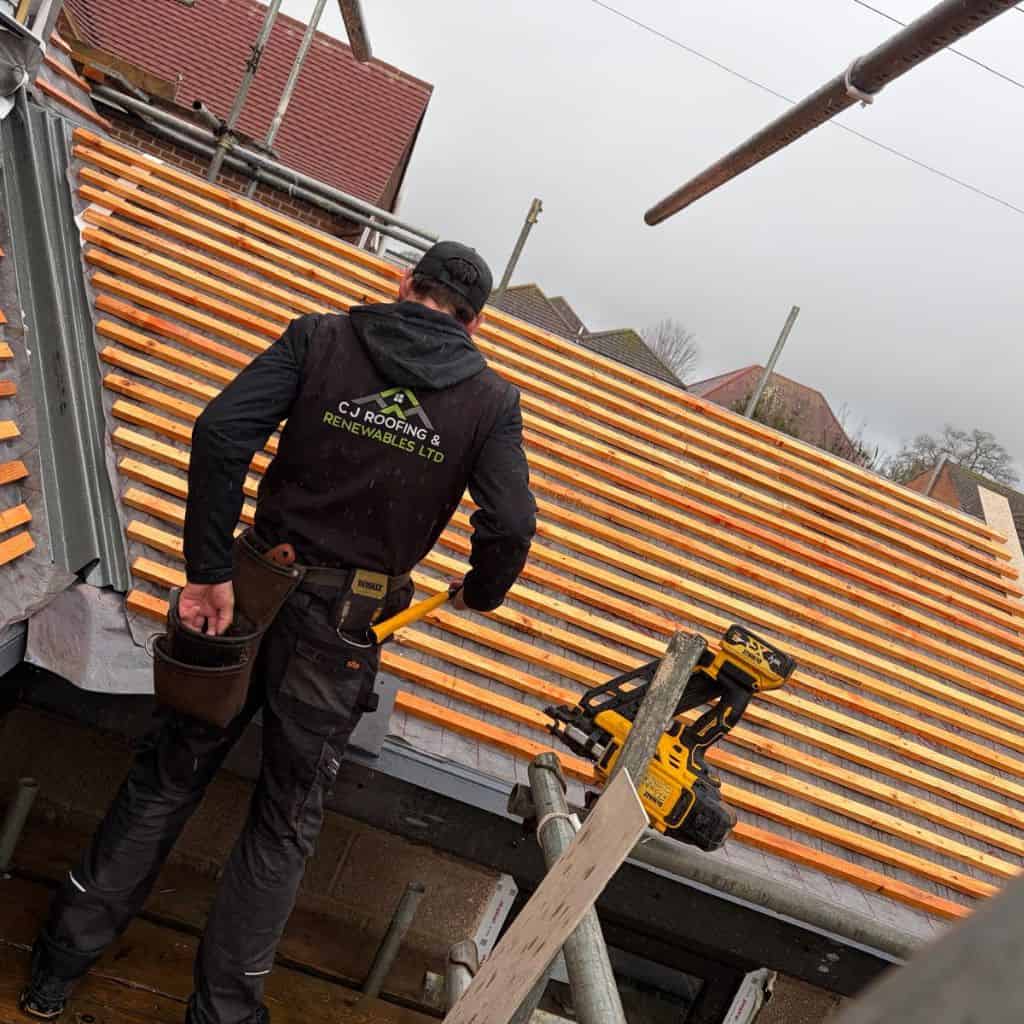
Replacement becomes necessary when damage affects a significant portion of the roof surface. A sagging deck or compromised structure points to replacement, whereas isolated leaks or a few dislodged tiles will typically require only a roof repair.
Common indicators include:
Daylight visible through the loft after a dry afternoon
Daylight visible through the loft after a dry afternoon indicates significant failures in the tiles, flashing or felt joints that allow water to penetrate the structure. When this affects a substantial portion of the roof surface, replacement is generally the appropriate course of action rather than a series of isolated repairs.
Sagging rafters or visibly dipped ridge
Sagging rafters or a visibly dipped ridge indicate that the deck or underlying structure has been compromised. At this stage the roof requires full replacement, as the structural integrity can no longer support ongoing patching or individual tile repairs.
Granules accumulating in gutters from concrete tiles
Granules accumulating in gutters from concrete tiles indicate surface wear and a covering that is approaching the end of its lifespan. This gradual degradation points to widespread tile deterioration rather than a localised fault, and is one of the more common signs that replacement is approaching.
Spongy feeling underfoot in the loft
A spongy feeling underfoot in the loft indicates that the battens or rafters beneath the roof covering have rotted and can no longer perform their structural role. When the deck has failed in this way, replacement of the covering and affected timbers is required.
Brown tide-marks appearing on bedroom ceilings
Brown tide-marks appearing on bedroom ceilings after rain indicate that water is penetrating through the roof deck and spreading across multiple areas. When staining appears in several locations simultaneously, it points to widespread failure across the covering rather than a single, traceable leak.
Our roof inspections provide the objective, evidence-based assessment needed to establish whether defects are isolated or symptomatic of widespread structural failure. By examining both the exterior surface and the internal decking, we give you an accurate picture of the roof’s condition – without pressure to proceed further than is genuinely necessary.
If you notice any of these signs, contact us at 07512976384 for a survey.
How long does a roof replacement take?
A typical roof replacement takes three to seven working days. Larger properties may extend to two weeks or more, and steep pitches or complex valley work can add further time to the schedule.
We deploy a dedicated roofing team to keep the project moving efficiently. Dry-fix systems accelerate ridge and verge detailing, and most domestic projects conclude within a week when weather conditions are favourable.
Winter months introduce the possibility of delays, as rain, frost and wind gusts above 25 mph will halt work. Scheduling between April and September offers the longest uninterrupted working periods.
What does our roof replacement process involve?
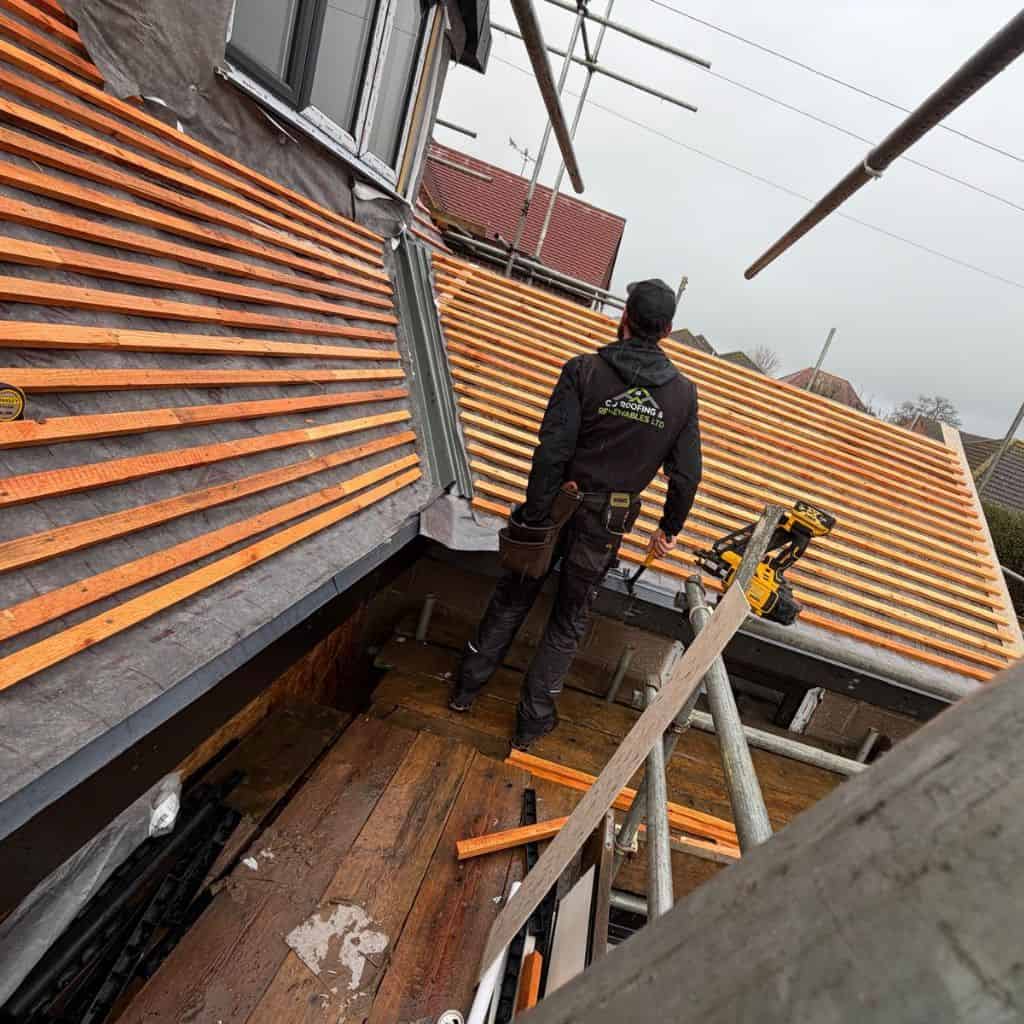
Our roof replacement process follows five stages: survey, scaffold, strip, deck check, and membrane, tiling, finishing and documentation. Each stage is recorded with dated photographs, giving you a complete visual record from initial assessment through to final completion.
Our on-site procedures include:
Survey: assess rafter condition, tile state, chimney lead, and loft
At survey stage we assess rafter condition, tile state, chimney lead and the loft interior. Our roof inspections provide objective, evidence-based findings to establish whether defects are isolated or indicate widespread structural failure.
Most projects conclude without unexpected structural work, as the initial survey identifies potential issues before work begins. You receive a clear account of what was found, supported by photographs, so the scope of any replacement is fully transparent.
Scaffold: install edge protection, debris chutes, and boundary fans
At scaffold stage we install edge protection, debris chutes and boundary fans. We coordinate scaffolding, access and noise management with neighbours before any work begins.
Where scaffolding is positioned on a public road, councils require a licence, and we submit the necessary applications along with public liability certificates in advance. For terraced properties where scaffolding may cross two front gardens, we obtain permission from neighbours before installation proceeds.
Strip: remove old tiles, felt, and battens down to rafters
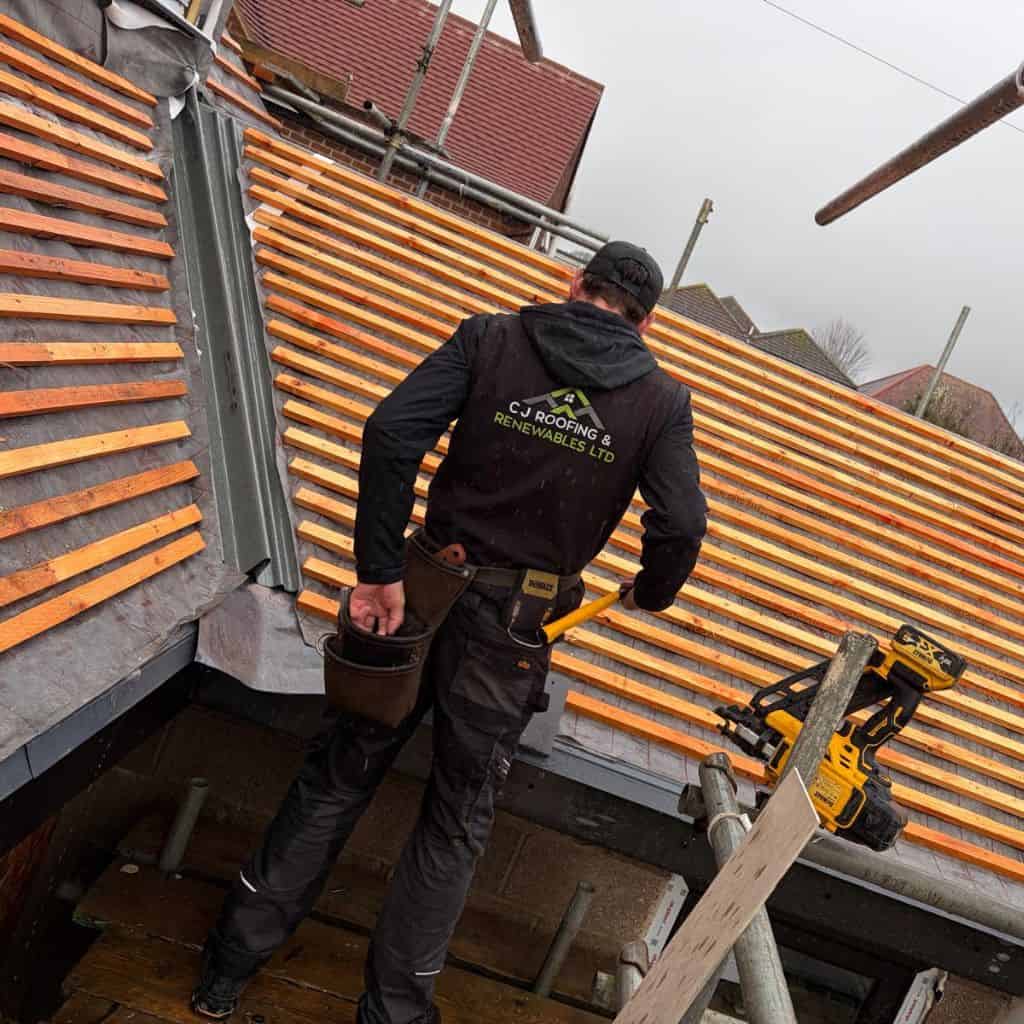
At strip stage we remove old tiles, felt and battens down to the rafters, clearing the roof to its structural frame. This full strip-back is what allows a replacement to resolve problems that repairs cannot – persistent leaks, rotting timbers, and a covering that has consistently required attention.
Deck check: replace rotten, woodworm-infested, or undersized timbers
At deck check stage we replace any rotten, woodworm-infested or undersized timbers. Our structural checks cover rafter condition, purlin sag, wall plate decay and chimney stability.
In older properties, rot is frequently concealed behind tiles that appear sound from the outside. Where movement is detected, a structural surveyor joins the survey, and building control may require calculations before approving rafter replacement. For pre-1940 properties, new rafters and wall plates may need to be installed before the strip work begins.
Membrane, tile, finish, documentation: install underlay, lay tiles, add flashings, photograph all stages
At the final stage we install breathable underlay, lay tiles from eaves to ridge with mechanical fixings, install ridge bedding or dry ridge with lead flashings, reconnect the gutters, and document each stage with dated photographs. Workmanship guarantee documents are issued on completion, and building control sign-off is registered for any structural changes.
Which materials suit roof replacement?
Clay tiles, concrete tiles, natural slate and metal sheets are all suitable materials for UK roofs. The appropriate choice depends on roof pitch, planning regulations and the style of the property.
- Natural slate for period properties
- Handmade clay for conservation areas
- Interlocking concrete for modern estates
- Single-ply membrane or standing-seam metal for pitches under 15 degrees
- Fibre cement slates for exposed coastal areas
Natural slate has a lifespan of 80 to 100 years, with Welsh, Spanish and reclaimed slate each offering distinct profiles and lead times. Concrete interlocking tiles are suitable for most post-war homes.
Where asbestos is present in older structures, removal requires a licensed specialist contractor. When asbestos is detected, we refer its removal to a licensed contractor for sealed disposal with air monitoring in place. Our team is fully trained in asbestos awareness.
Our quotes specify the supplier and product code, and conservation-area clay tiles include a colour batch reference.
How does the new roof integrate with insulation and chimney flashing?
The new roof is integrated with insulation, ventilation and chimney flashing as part of the construction process. Eaves trays connect the insulation, ridge or tile vents manage airflow, and new Code 4 lead dressings secure the chimney joint. Building Regulations Part L requires a minimum U-value of 0.18 W/m²K.
Eaves trays keep loft insulation clear of the felt edge, maintaining ventilation in the cold roof void, while mineral wool prevents soffit gaps from becoming blocked. We use a breathable membrane with ridge vents to maintain airflow throughout.
Ridge ventilation, new lead step flashing and upgraded insulation can all be completed in a single visit. Code 4 lead flashings typically last 50 to 60 years on sheltered sites, though coastal exposure reduces that lifespan, so we replace them on most older properties at the same time as the tiles.
Why Choose C J Roofing & Renewables Ltd for Roof Replacement in Hampshire?
Over 15 years of experience
Connor and Jack bring over 15 years of combined hands-on roofing experience, delivering everything from small domestic repairs to large-scale commercial projects across Hampshire.

Locally based in Hampshire
Based in Portsmouth with deep local roots, we understand Hampshire's homes, weather and building styles, which allows us to deliver roofing work that lasts.
5-star rated service
We are proud to be rated 5 stars on Google by our customers, reflecting the quality of our workmanship and our commitment to reliable, professional service.
Competent & highly trained team
Our team is fully trained and certified in asbestos awareness, working at height and manual handling, ensuring every project is carried out safely and to industry standards.
£5 million public liability insurance
We carry up to £5 million in public liability insurance, giving you complete peace of mind that your property is fully protected while we work.
10 year workmanship guarantee
All new roof installations and replacements come with a 10-year workmanship guarantee, so you are covered in the unlikely event of any issues.







Frequently asked questions
Take a look at the Frequently Asked Questions regarding our Roof Replacement service.
Do you need to stay elsewhere during the work?
Most roof replacements allow you to remain in your home throughout. The property is kept watertight overnight and the deck is covered with tarps at the end of each working day. Noise is confined to working hours, dust remains outside, and the loft hatch is sealed with plastic sheeting.
Move garden furniture and any fragile items away from external walls before work begins. Certain circumstances may make staying elsewhere preferable:
- Families with newborns may prefer to be away for a couple of nights during the strip stage
- Shift workers may find a quiet room at the back of the house more suitable
- Pets often benefit from a short stay elsewhere during the noisier phases
The majority of homeowners remain in their homes for the full duration of the project.
What structural checks happen before work begins on older properties?
Our structural checks cover rafter condition, purlin sag, wall plate decay and chimney stability. We lift a selection of tiles to inspect the deck and probe timbers for soft spots.
In older properties, rot is frequently concealed behind tiles that appear sound from the outside. Where movement is detected, a structural surveyor joins the survey, and building control may require calculations before approving rafter replacement.
For pre-1940 properties, new rafters and wall plates may need to be installed before the strip begins. A full structural assessment by a chartered surveyor avoids unexpected discoveries during the project. Listed buildings and properties in conservation areas require planning officer consent before any rafter work can proceed.
How are weather delays managed to protect the exposed structure?
Weather delays are managed through daily tarp-down routines, scaffold sheeting and regular forecasting. Our team strips only what can be re-covered before the end of each working day.
Four weather-related risks are monitored throughout every project:
- Wind gusts that can lift tiles and rip felt
- Heavy rainfall
- Frost on battens that prevents safe nailing
- Short winter daylight hours that reduce the working window
Wind poses a greater risk than rain. Work halts when gusts exceed safe limits; additional tarps are secured and battens weighted during storms, with work resuming once gusts subside and surfaces dry. Some winter projects extend by two days or more, while summer schedules typically remain on track.
What warranties cover the new roof?
Manufacturer warranties for tiles and slates range from 30 to 50 years, and our workmanship guarantee covers a period of 10 years. Guarantee documents are issued on completion, and building control sign-off is registered for any structural changes.
Retain this documentation along with the manufacturer batch numbers for tiles and membranes. These details simplify any future claim and assist buyers during conveyancing if the property is sold within the warranty period.
Should a leak occur within the 10-year workmanship guarantee period, a claim can be made under our coverage, and emergency repairs are prioritised alongside new work.
How do you handle scaffolding, access, and noise around neighbours?
We coordinate scaffolding, access and noise management with neighbours for every project. A note to adjoining properties in advance is helpful, as scaffolders may need to anchor to a party wall or make temporary use of a neighbouring driveway.
Where scaffolding is positioned on a public road, councils require a licence, and we submit the necessary applications along with public liability certificates in advance. For terraced properties where scaffolding may cross two front gardens, permission from neighbours is obtained before installation begins.