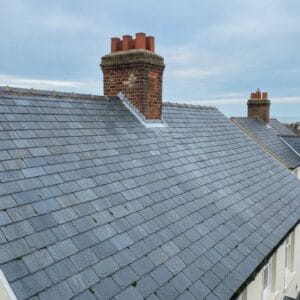
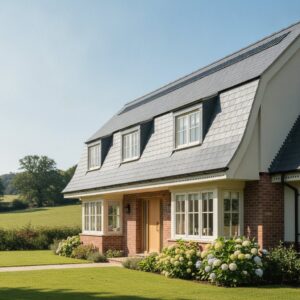
How to Choose the Right Slate Roofing for Your Hampshire Home
17 September 2026
To choose the right slate roofing for your Hampshire home, match the slate type to your property's age, roof pitch,…
EPDM roofing suits Hampshire flat roofs because it handles our coastal weather, lasts for decades, and seals as a single continuous sheet. For most homeowners, it offers a lower-maintenance covering that copes with wide temperature swings without splitting. Below we look at the practical reasons it works well here, how it compares to felt, and what affects the right choice for your roof.
The main EPDM flat roofing benefits are long service life, a seamless watertight finish, flexibility through temperature changes, and resistance to UV and ponding water. These qualities make it a dependable covering for garages, extensions, dormers, and porches.
EPDM is a synthetic rubber membrane engineered to move with your deck. As the roof warms in summer and cools overnight, the rubber flexes rather than hardening and cracking. This matters on exposed Hampshire roofs that face long days of sun followed by sharp drops in temperature.
EPDM roofing is well suited to Hampshire homes because our climate combines coastal wind, salt air, driving rain, and swings between cold winters and hot summer roof surfaces. A flexible rubber membrane copes with all of these without losing its seal.
Properties near the water in Portsmouth, Gosport, Hayling Island, and Lymington face salt-laden air that can shorten the life of some materials. EPDM is chemically stable and resists this exposure well. Inland, around Basingstoke, Andover, and Alton, the bigger challenge is the daily temperature range, which EPDM handles through its natural flexibility.
We install EPDM across the county, sizing each sheet to the deck and bonding it fully so wind cannot lift it. On exposed coastal roofs, a fully bonded membrane with well-dressed edges gives you a covering built for local conditions.
In the EPDM versus felt roofing comparison, EPDM typically lasts longer, has fewer seams, and flexes more readily with temperature change. Felt remains a familiar option, but it relies on lapped joints and bitumen layers that age faster under sun and movement.
Here is how the two measure up on the points homeowners ask about most:
If your felt roof is bubbling, blistering, or holding water, a recover with EPDM is often the sensible next step. You can read more about the signs and the installation process on our EPDM Roofing page.
EPDM works best on flat and low-pitch roofs such as garages, single-storey extensions, dormers, porches, and bay window tops. Anywhere water needs a reliable, seamless covering, a rubber membrane is a strong fit.
Because the sheet can be dressed cleanly around upstands, pipes, and outlets, it suits roofs with several penetrations. On larger decks we plan the layout so joints fall in the lowest-risk positions, and we finish every edge and outlet carefully to keep the roof watertight.
The right EPDM specification depends on your deck size, the number of upstands and outlets, the roof’s exposure, and the condition of the structure beneath. These factors shape the membrane grade and the detailing needed.
We assess each of these during a free, director-led site survey. Rather than quote a figure blind, we look at your actual roof and set out what it needs. You then receive a written, itemised quote within 48 hours of the visit, so you can make a clear decision with no pressure.
We bring over 15 years of combined hands-on roofing experience to flat roofing work across Hampshire and the South of England. Our team is fully trained and certified in asbestos awareness, working at height, and manual handling, and we carry £5 million public liability insurance.
Every new EPDM installation is covered by our 10-year workmanship guarantee. We size each sheet to your deck, bond it fully, and dress every upstand and outlet to a clean finish. Based in Portsmouth, we serve Southampton, Fareham, Waterlooville, Havant, Eastleigh, Petersfield, Fleet, and the wider region.
We believe in honest, no-pressure advice. If a simple repair would serve you better than a full recover, we will tell you.
If your flat roof is ageing or you are planning an extension, book a free director-led site survey and we will set out your options in plain English. Call us on 02393873756 or request a quote online. We respond within 48 hours.
Posted by: Connor Stanley
Date: 1 October 2026