
Gutter Inspection Hampshire
Gutter Inspection Services in Hampshire
A gutter inspection is the most reliable way to identify faults before heavy rainfall causes significant damage to your walls, fascia and foundations. Regular inspections uncover joint leaks, slipped brackets, soft fascia timber and blocked downpipes, allowing for modest repairs that prevent far more serious problems developing.
C J Roofing & Renewables Ltd specialises in gutter inspections across Hampshire. Our process covers the full gutter run from ground level and at ladder height, with every defect recorded in a photographic report so you have a clear account of the condition of your system.
Your written, itemised quote follows within 48 hours of the inspection. Call 07512976384 for a free quote. We respond within 48 hours.

What are the signs you need a gutter inspection?
Recognising the early signs of gutter problems can prevent significant water damage to your property. Watermarks running down rendered walls, dripping joints during rain, plant growth inside the channel, and damp patches near the eaves all indicate that an inspection is warranted. Each sign points to a fault that will worsen with sustained rainfall.
Common indicators include:
Water cascading over the front lip during normal rain
Water cascading over the front lip of the gutter during normal rainfall indicates that the channel is blocked or the fall is incorrectly set. This overflow can damage walls, fascia and foundations as water bypasses the downpipe system entirely.
Overflow events often leave brown staining on brick or render below the gutter line. Prolonged exposure can rot the fascia behind the gutter, requiring considerably more extensive repairs than simply clearing the original blockage.
Drip lines on fascia paint between brackets
Drip lines on fascia paint between brackets indicate that water is leaking from joints or that the gutter is not seated correctly. This points to slipped ferrules, cracked joints, or brackets that have loosened over time.
Gutter brackets loosen as the timber behind them softens, causing the gutter to drop and the slope to flatten. Water then pools rather than flowing to the outlet, exacerbating the leak and potentially rotting the fascia further.
Moss tufts or grass protruding from the gutter channel
Moss tufts or grass protruding from the gutter channel indicate accumulated organic matter and standing water. Leaves, moss mats and bird nests obstruct the channel and prevent proper water flow to the downpipe.
Properties beneath oak, sycamore and lime tree canopies experience rapid gutter filling after autumn leaf fall. A single annual inspection may miss significant blockages, making two inspections per year advisable to keep channels clear during winter storms.
Brown staining on brick or render below the eaves
Brown staining on brick or render below the eaves indicates overflow events or joint leaks allowing water to run down the wall. This staining is often a late warning sign that the gutter system has been failing for some time.
Coastal Hampshire terraces are particularly vulnerable to south-westerly winds driving rain against parapet returns. A 1930s semi-detached property may display a rust streak below the rear bay, often traced back to a hairline crack in the cast iron stop end.
Soft spots in soffit or rotten timber visible from windows
Soft spots in the soffit, peeling paint on the fascia, or rotten timber visible from an upstairs window all indicate prolonged capillary water exposure behind the gutter. This type of damage frequently requires fascia replacement in addition to gutter repair.
Cast iron systems often exhibit ferrule slip when the cast lug securing the socket to the bracket corrodes. As the bolt loosens, the joint drops a few millimetres, and water penetrates behind the gutter, rotting the timber over time.
Brown staining on brick or render below the gutter line may indicate overflow events. Coastal Hampshire terraces are particularly vulnerable to south-westerly winds driving rain against parapet returns.
A 1930s semi-detached property may display a rust streak below the rear bay, often traced back to a hairline crack in the cast iron stop end. Prolonged capillary water exposure can rot the fascia behind. Contact us at 07512976384 for a survey.
How often should you book a gutter inspection in Hampshire?
An annual gutter inspection is advisable for most Hampshire homes. Properties beneath a dense tree canopy may require a second visit after autumn leaf fall. Tree cover and the age of the roof are the principal factors in determining the appropriate inspection schedule.
Properties beneath oak, sycamore and lime tree canopies experience rapid gutter filling after leaf drop. A single annual visit may miss significant blockages, making two inspections per year necessary to keep channels clear during winter storms.
By contrast, newer estates with sparse planting may be suitable for a single inspection every 18 months. Coastal properties face salt spray that accelerates corrosion on aluminium and steel components, making an early autumn check each year advisable.
Listed buildings and Victorian terraces with cast iron systems require more frequent inspections due to the degradation of original ferrules over time. Rental properties and holiday lets benefit from biannual surveys, with records supporting any insurance claims for water ingress.

What does our gutter inspection in Hampshire cover?
Our gutter inspection covers six core checks on every visit, with each step documented in a written report including our recommendations.
Our on-site processes include:
Fall: Measure each bracket point with digital level for 1 in 600 slope
We measure each bracket point using a digital level, working to a 1 in 600 slope to ensure proper water flow to the outlet. Sagging runs where brackets have loosened over time cause the slope to flatten and water to pool.
A correct fall prevents standing water that accelerates corrosion and organic build-up. Any bracket points found to be out of level are documented with recommendations for repositioning or replacement.
Joints: Inspect every union, stop end, and outlet
We inspect every union, stop end and outlet for leaks, cracks or separation. Hairline cracks on uPVC stop ends and mitres are common failure points, particularly on modern homes.
Joint leaks are documented with photographs and a brief description of the recommended repair. Cast iron systems are checked for ferrule slip resulting from years of corrosion that can cause joints to drop.
Fascia: Examine timber behind gutter at 1-metre intervals
We examine the timber behind the gutter at 1-metre intervals, probing for soft spots and rot. Peeling paint on the fascia frequently conceals underlying timber degradation from water exposure.
Rotten timber visible from an upstairs window is flagged as requiring urgent attention. The report includes photographs and recommendations for fascia repair or replacement alongside any gutter work.
Downpipes: Flush each with 10-litre bucket to ensure flow
We flush each downpipe with a 10-litre bucket to confirm flow from the hopper to ground level. Blocked downpipes are the most frequently reported issue in our surveys, with leaves, moss and debris obstructing the channel.
We also check the gulley and the first metre of the underground run, using a water flow test to identify most drainage faults without lifting a drain cover. Slipped joints between socketed lengths and corrosion on cast iron above the shoe are common faults.
Photos: Map every defect onto sketch plan with report within 48 hours
We map every defect onto a sketch plan of the roof and provide a written report within 48 hours of the initial inspection. Each item includes a photograph with a brief description of the recommended repair and a quote for any work identified.
The report documents the gutter material, profile and age. Homes built before 1960 often feature original cast iron, while modern uPVC properties display varied failure patterns at corner mitres. The report also serves as an insurance record for water-ingress claims.
What faults turn up most often during a gutter inspection?
Blocked downpipes, sagging gutter runs and slipped ferrules are among the most common faults identified during a gutter inspection. Joint leaks, fascia rot and corroded cast iron sections are also frequently encountered. Blockages are the most commonly reported issue in our surveys.
The fault list includes six primary issues:
- Leaves, moss mats and bird nests obstructing the channel
- Hopper heads filled with twigs on three-storey townhouses
- Sagging runs where brackets have loosened over time
- Cast iron ferrule slip after years of corrosion
- Hairline cracks on uPVC stop ends and mitres
- Asbestos cement downpipe sections on older housing (referred to a licensed contractor)
Sagging runs are the second most common issue. Gutter brackets loosen as the timber behind them softens, causing the gutter to drop, the slope to flatten and water to pool rather than flow to the outlet.
Cast iron systems often exhibit ferrule slip when the cast lug securing the socket to the bracket corrodes. As the bolt loosens, the joint can drop a few millimetres.

Do you carry out inspections in bad weather?
Inspections are conducted within safe wind, temperature and rain limits as set by Working at Height regulations. Visits are rescheduled whenever conditions fall outside those limits. Ladder work and scaffold tower operations each have manufacturer wind limits that we observe.
Light drizzle rarely prevents a survey. Heavy rain can hinder photography and make fascia probing unreliable, while frost on tiles renders elevated work unsafe regardless of wind speed.
Where conditions are unsuitable, our engineer will contact you with options: either rescheduling the visit by a day or two, or completing a hybrid survey in which ground-level work is carried out first and elevated work is scheduled for the next dry day. A north-facing roof in January can remain frosty until early afternoon, so elevated work on such bookings is planned for later in the day.
Why Choose C J Roofing & Renewables Ltd for Gutter Inspection in Hampshire?
Over 15 years of experience
Connor and Jack bring over 15 years of combined hands-on roofing experience, delivering everything from small domestic repairs to large-scale commercial projects across Hampshire.

Locally based in Hampshire
Based in Portsmouth with deep local roots, we understand Hampshire's homes, weather and building styles, which allows us to deliver roofing work that lasts.
5-star rated service
We are proud to be rated 5 stars on Google by our customers, reflecting the quality of our workmanship and our commitment to reliable, professional service.
Competent & highly trained team
Our team is fully trained and certified in asbestos awareness, working at height and manual handling, ensuring every project is carried out safely and to industry standards.
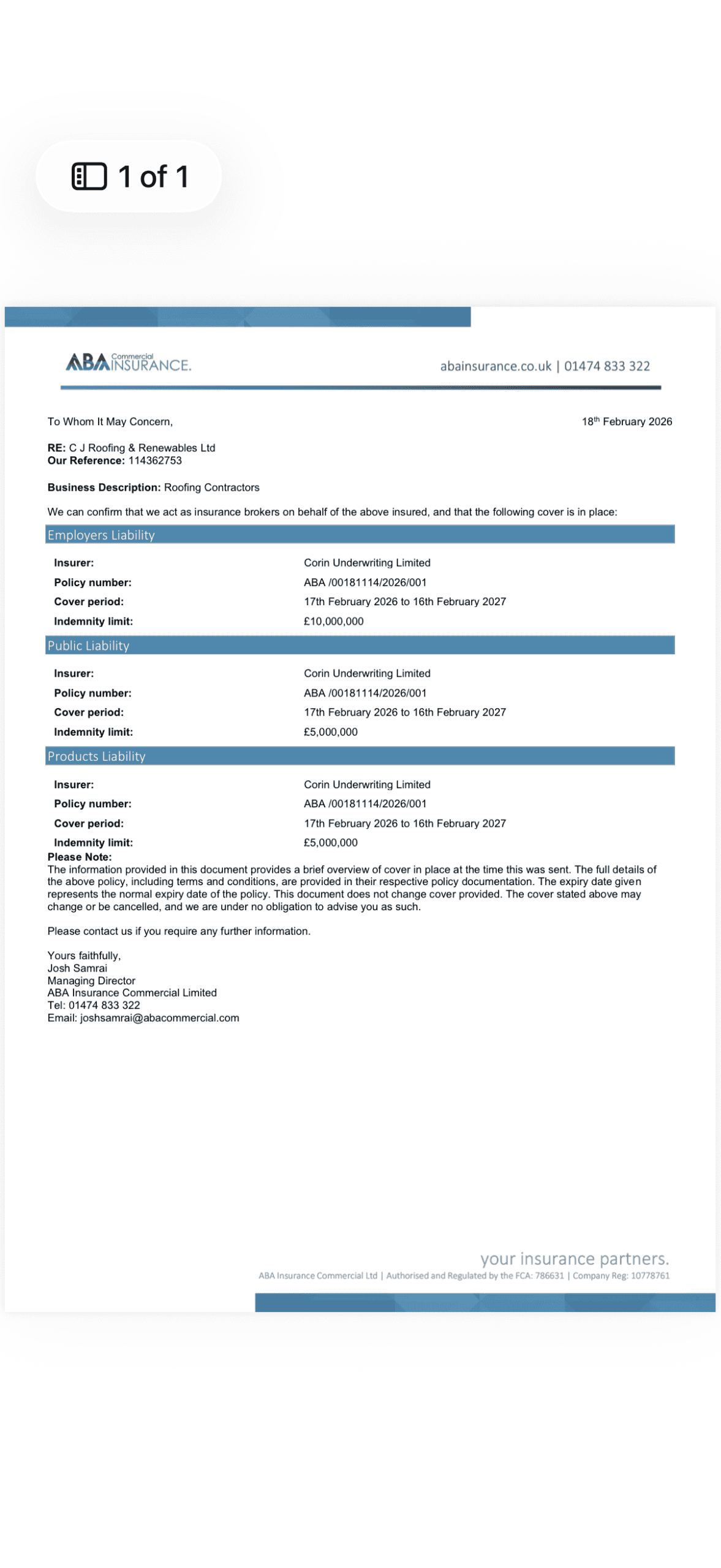
£5 million public liability insurance
We carry up to £5 million in public liability insurance, giving you complete peace of mind that your property is fully protected while we work.
10 year workmanship guarantee
All new roof installations and replacements come with a 10-year workmanship guarantee, so you are covered in the unlikely event of any issues.






Frequently asked questions
Take a look at the Frequently Asked Questions regarding our Gutter Inspection service.
Is a post-storm gutter inspection worth booking?
Booking a gutter inspection after significant wind or rain events is advisable. Hampshire regularly experiences south-westerly fronts, and the Met Office records several named storms most winters.
Wind can displace tiles, snap brackets and lift hopper covers. Heavy rain can force water past compromised joints that handle lighter rain without issue. Even a robust system can lose a downpipe clip during a single overnight storm.
The morning after a storm, walk your property boundary and look upward. Check for displaced ridge tiles and missing slates, and note any torn flashing or gutters hanging from a single bracket. A piece of dark plastic on the ground may indicate a snapped uPVC clip; a length of cast iron in the flowerbed may mean a section has detached from the run.
How soon can you book us in?
We respond to inspection enquiries within 48 hours. Storm responses and active leaks are prioritised, with a 24-hour emergency response available when water is actively entering the property. You can send a photograph of the issue by email and our team will assess the urgency from the image.
What if the inspection finds urgent repairs?
Our team will identify any urgent repairs required on the day of the visit. We are able to provide a make-safe temporary fix where needed, and a permanent repair quote is sent within 48 hours. Urgent repairs encompass active water ingress, unsafe sections at risk of falling, and damage threatening the building fabric.
Can you inspect multi-storey or three-storey homes?
We conduct multi-storey inspections using scaffold towers. Building height and ground conditions determine the access plan, with three-storey townhouses requiring elevated access equipment.
Does the inspection cover downpipes and drainage?
Every gutter inspection includes the downpipes from the hopper to ground level. We check the gulley and the first metre of the underground run, using a water flow test to identify most drainage faults without lifting a drain cover.
Common downpipe faults include slipped joints between socketed lengths and corrosion on cast iron above the shoe. Root ingress into the gulley can occur on plots with mature trees, where roots push through joint mortar and cause blockages.
Below ground, clay pipework from pre-1980s housing can crack at the rocker joint where the gulley meets the run. On older properties with mature sycamore trees nearby, root mass may be found at the gulley trap, requiring a drainage specialist for further investigation.