EPDM Roofing Hampshire
EPDM Roofing Services in Hampshire
EPDM is a single-ply synthetic rubber membrane that is well suited to residential flat roofs. Unlike traditional felt, it flexes through wide temperature swings, adapting to cold Hampshire winters and hot summer surfaces alike, without splitting or losing seal strength. Most domestic decks are covered with one continuous sheet, removing the lap seams that are the most common failure point in felt builds.
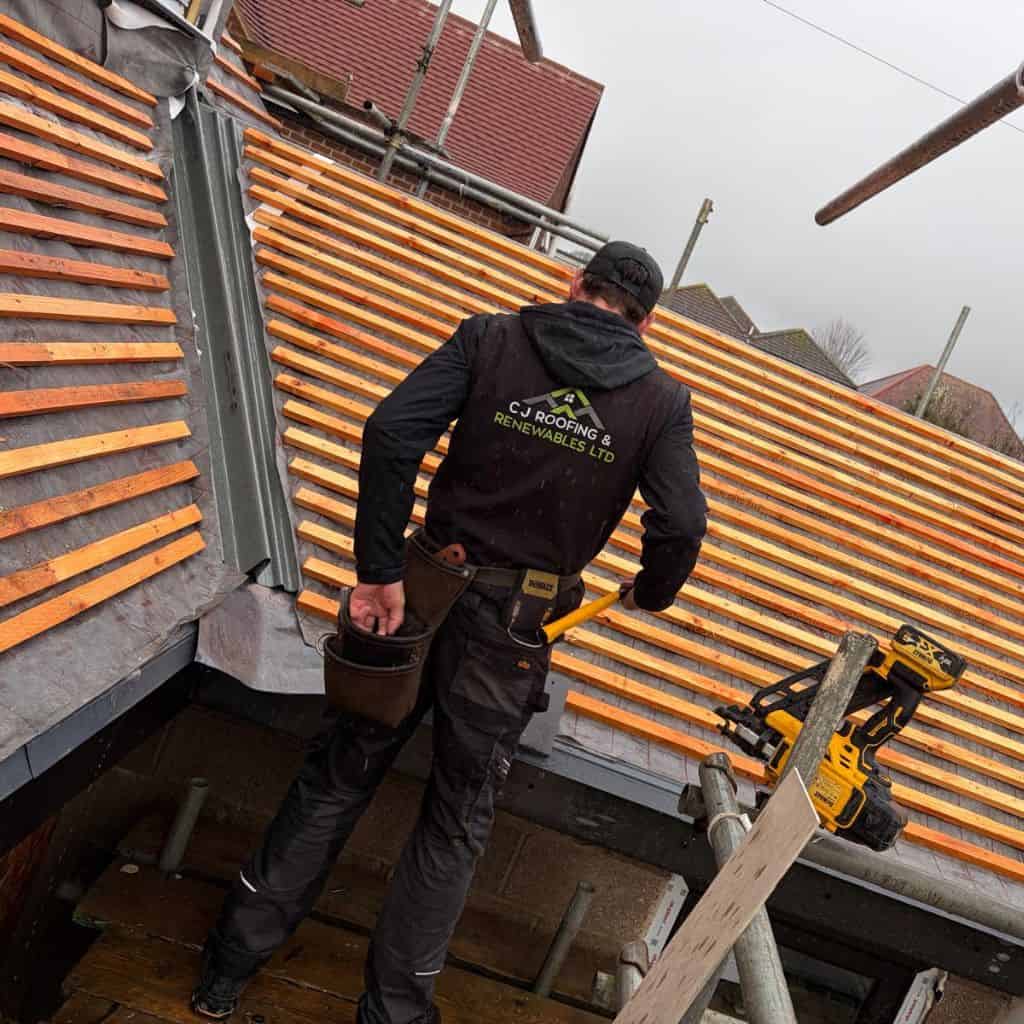
C J Roofing & Renewables Ltd installs EPDM flat roofs across Hampshire. We size each sheet to your deck, bond it down fully, and dress every upstand and outlet to a clean finish. All new installations are covered by our 10-year workmanship guarantee.
Your written, itemised quote follows within 48 hours of the survey. Call 07512976384 for a free site visit. We respond within 48 hours.
How can you tell your flat roof needs a new EPDM covering?
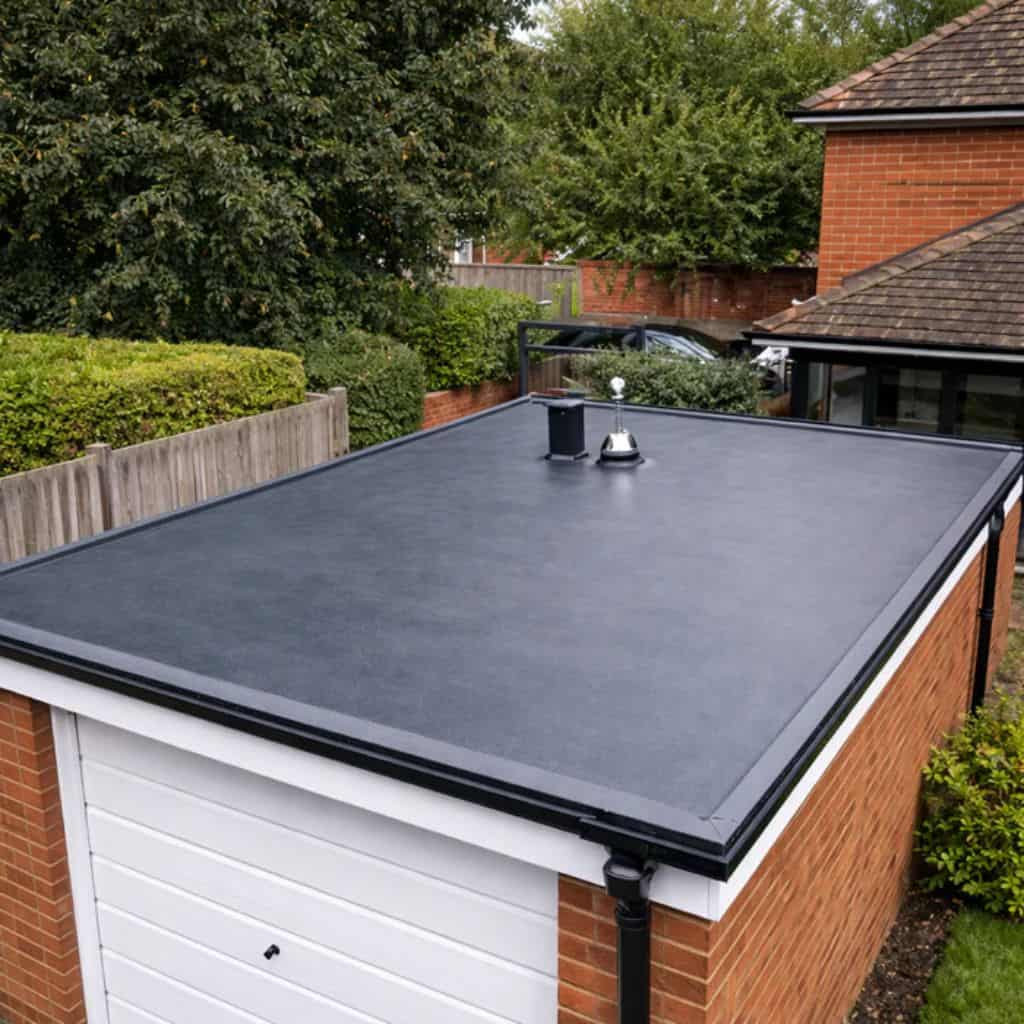
A flat roof is ready for a new EPDM covering once the felt begins to bubble, lap seams start to split, or water sits on the surface for more than 48 hours. Old felt shows its age quickly, and EPDM rubber is well suited to replacing it on a flat roof.
Common signs that point to a recover include:
Bubbling, blistering, or peeling felt across the field
Bubbling, blistering, or peeling felt across the roof field indicates that moisture has become trapped within the covering and that the bitumen layers are failing. As felt ages, it loses its flexibility and can no longer accommodate the thermal movement of the deck beneath it.
EPDM rubber is well suited to replacing old felt in these circumstances, as it adapts to both cold winters and hot summers without cracking. A single, seamless sheet also removes the lap seams that are the most common failure points in traditional felt builds.
Open seams where two sheets meet at a lap
Open seams where two sheets meet at a lap indicate that the adhesive has failed and the membrane is no longer watertight. Traditional felt roofs have multiple lap seams that can catch water and allow ingress to develop over time.
EPDM seals against rain, frost, and UV damage in a single piece, removing the failure point inherent in old bitumen builds. Most domestic extensions are covered with one continuous sheet: no field seams, no weak joints.
Soft spots underfoot suggesting wet deck timbers
Soft spots underfoot suggest that water has penetrated the old covering and is saturating the deck timbers beneath. We probe every square metre with a moisture meter and screwdriver; readings below 18% confirm the deck is sufficiently dry for EPDM to be installed over it.
We replace any soft boards, punch loose fixings 2mm below the surface, and check perimeter timbers for rot before bonding the new membrane. A felt covering can appear intact at the surface while EPDM blisters within months over a wet deck, which is why verifying dryness at this stage is critical.
Brown staining on the ceiling below the roof
Brown staining on the ceiling below the roof indicates active water ingress through the flat roof covering. Water tracks down through the deck and into the room, damaging plaster and potentially encouraging mould growth.
EPDM bonds to timber, concrete, and PIR insulation boards, providing a robust waterproof layer that arrests ingress effectively. The membrane remains watertight long after felt would have failed, protecting the interior from further staining.
Standing puddles 48 hours after rain stops
Standing puddles remaining on the roof 48 hours after rain has stopped indicate that the deck either lacks sufficient fall or has deformed, causing water to pond. EPDM can tolerate short ponding of up to 48 hours without deteriorating, which traditional felt cannot reliably match.
Decks falling at 1:80 drain to outlets at one corner, while decks with a fall below 1:40 require tapered insulation or firrings to create proper drainage. The membrane performs reliably through UK rain, wind, hail, and frost without cracking, blistering, or losing seal strength.
If you have noticed any of these signs, call us on 07512976384 for a free survey.
What is EPDM roofing and why does it suit Hampshire flat roofs?
EPDM roofing is a single-ply synthetic rubber membrane bonded to a flat or low-slope deck. The sheet seals against rain, frost, and UV damage in a single piece, without the lap seams that make traditional felt vulnerable to water ingress.
EPDM rubber flexes through wide temperature swings. A south-facing roof can move from cold overnight lows to hot summer surface temperatures, and the membrane moves with the deck rather than splitting under that stress.
Most domestic extensions are fitted with one continuous sheet (no field seams and no weak joints), which removes the failure point common to old bitumen builds.
EPDM can also tolerate short ponding without deteriorating, and the salt air found across coastal Hampshire will not degrade the rubber. Garages, dormers, porches, balconies, and garden offices are all well suited to this flat roof installation system.
What does our EPDM roofing installation process involve?
Our EPDM roofing installation follows five stages: survey, strip, deck preparation, bonding, and perimeter detailing. Every job begins with a free site survey carried out by a director.
What we carry out on site:
Survey: measure deck, photograph defects, log moisture readings
We begin every job with a free site survey from a director, measuring the deck, photographing defects, and recording moisture readings. The deck must fall within 3mm of flat over a 2-metre run to drain properly.
We assess deck size, pitch, exposure, and the build-up below to determine the appropriate EPDM specification. Sheet thickness, insulation grade, and edge detail are all decided on the basis of these four factors.
Strip: lift old covering, replace soft boards, sweep twice
The old covering is lifted and removed, and any soft boards are replaced with new timber. We sweep the deck thoroughly twice to ensure all debris is cleared before preparation begins.
We vacuum the deck a second time before primer is applied, so no dust or grit remains that could prevent proper adhesion. On a tired extension, OSB sheets may need to be replaced if the original deck has been compromised.
Deck prep: prime surface, dry it, check for dust or grit
The surface is primed and allowed to dry, with careful checks to confirm that no dust or grit remains that could prevent the membrane from bonding correctly. Moisture readings below 18% confirm the deck is sufficiently dry for EPDM installation.
EPDM roofing is a single-ply synthetic rubber membrane bonded to a flat or low-slope deck. Thorough deck preparation is essential to ensure the membrane adheres correctly and achieves a service life of 40 to 50 years.
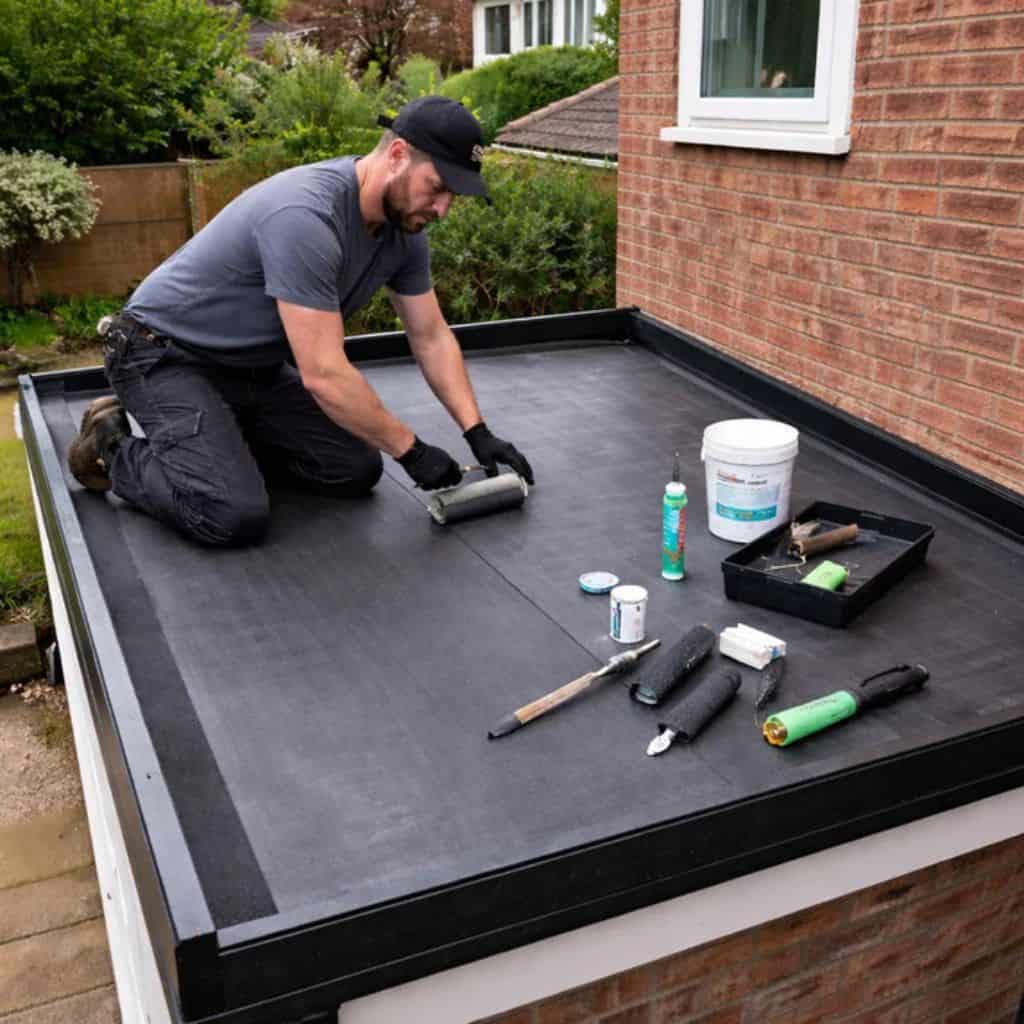
Bond: roll out EPDM sheet, relax it, then bond with adhesive
The EPDM sheet is rolled out across the deck, allowed to relax fully, and then bonded down with adhesive. On most domestic decks we fit a 1.2mm sheet across the field, while larger commercial-style decks step up to 1.5mm.
The sheet seals against rain, frost, and UV damage in a single piece, flexing through wide temperature swings without splitting. A south-facing roof can swing from cold overnight lows to hot summer surface temperatures, and the membrane accommodates that movement without degrading.
Perimeter: dress into kerb trims, drip edges, and termination bars
The perimeter is dressed into kerb trims, drip edges, and termination bars, with the membrane locked into aluminium trims around the full edge. We bond the membrane to the deck first and then dress it into each trim in sequence.
Coastal Hampshire jobs are finished with marine-grade stainless steel fixings, while aluminium kerb is used on sheltered inland sites. All new installations are covered by our 10-year workmanship guarantee.
How do you choose the right EPDM spec for your roof?
The correct EPDM specification depends on deck size, pitch, exposure, and the build-up below. Sheet thickness, insulation grade, and edge detail are all selected around those four factors.
On most domestic decks we fit a 1.2mm sheet across the field, while larger commercial-style decks step up to 1.5mm. Smaller garage roofs can run a thinner sheet without any reduction in performance or service life.
Pitch governs the drainage approach:
- Decks at 1:80 fall to outlets at one corner
- Decks under 1:40 require tapered insulation or firrings
- Balconies and walkways require a walkway sheet over the field
Regardless of your property’s exposure, the installation is tailored to the specific wind load and drainage requirements of your roof.
How long does an EPDM rubber roof last in Hampshire?
An EPDM rubber roof can last 40 to 50 years on a sound, bonded deck. Manufacturer warranties run 20 to 25 years, and actual performance in service frequently extends beyond that.
The membrane resists ozone, hail, and biological growth, with foot traffic representing the greatest single factor that reduces service life. A garage roof accessed once a year can achieve its full lifespan, whereas a balcony walked daily without a protective walkway sheet will wear the surface over time.
Coastal properties can achieve comparable longevity to inland homes because salt does not degrade EPDM, and UV exposure does not cause it to crack. The membrane remains watertight long after felt would have failed in the same conditions.
All new EPDM flat roof installations by C J Roofing & Renewables Ltd carry a 10-year workmanship guarantee.
Why Choose C J Roofing & Renewables Ltd for EPDM Roofing in Hampshire?
Over 15 years of experience
Connor and Jack bring over 15 years of combined hands-on roofing experience, delivering everything from small domestic repairs to large-scale commercial projects across Hampshire.

Locally based in Hampshire
Based in Portsmouth with deep local roots, we understand Hampshire's homes, weather and building styles, which allows us to deliver roofing work that lasts.
5-star rated service
We are proud to be rated 5 stars on Google by our customers, reflecting the quality of our workmanship and our commitment to reliable, professional service.
Competent & highly trained team
Our team is fully trained and certified in asbestos awareness, working at height and manual handling, ensuring every project is carried out safely and to industry standards.
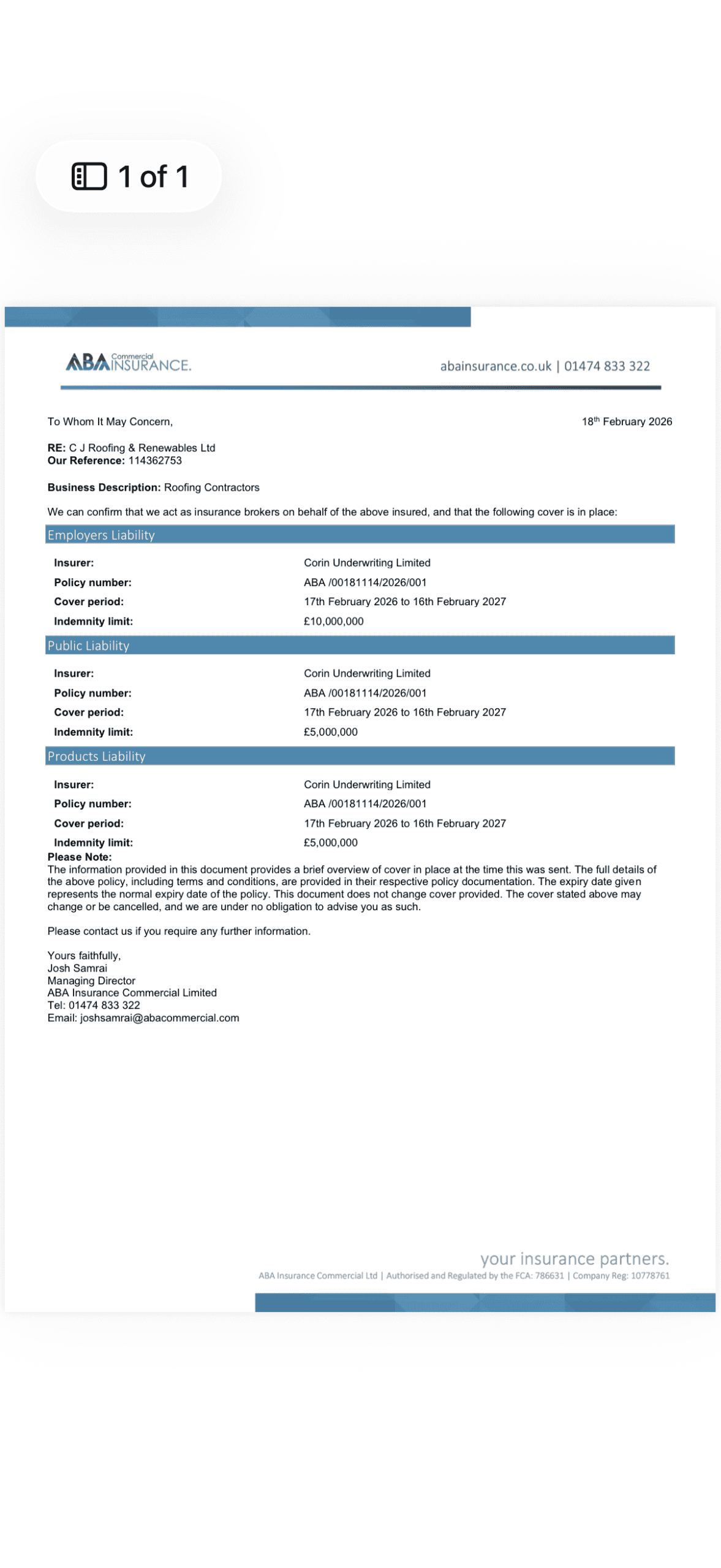
£5 million public liability insurance
We carry up to £5 million in public liability insurance, giving you complete peace of mind that your property is fully protected while we work.
10 year workmanship guarantee
All new roof installations and replacements come with a 10-year workmanship guarantee, so you are covered in the unlikely event of any issues.






Frequently asked questions
Take a look at the Frequently Asked Questions regarding our EPDM Roofing service.
Where does EPDM roofing work best in a Hampshire home?
EPDM works best on flat extensions, garages, dormers, porches, and balconies: anywhere the deck pitch remains below 10°. The system is well suited to most domestic flat roof replacements across Hampshire.
Shed roofs, summer houses, and garden offices all take the same membrane, and a single sheet can wrap an L-shaped extension without any field seams.
Common Hampshire applications include:
- Detached garages and outbuildings
- Single-storey rear extensions
- Dormer cheeks and dormer roofs
- Porches and bay window tops
- Garden offices and workshops
The membrane bonds to timber, concrete, and PIR insulation boards, and that adaptability suits most domestic build-up types.
How do you seal EPDM edges and joints?
EPDM edges are locked into aluminium kerb trims, drip edges, and termination bars. We bond the membrane to the deck first and then dress it into each trim, ensuring the edge is fully secured before moving on.
A single continuous sheet covers most field areas; larger roofs use factory splice tape to join sheets. Each seam receives a cleaner pass, primer, and a firm roller pass to achieve a full bond.
The correct metal for perimeter trim varies by location in Hampshire:
- Marine-grade stainless steel on the coast
- Aluminium kerb on sheltered inland sites
- Lead apron flashings at chimneys and abutments
Parapets are dressed with a separate flashing strip welded to the field sheet. Most leaks on poorly fitted EPDM roofs can be traced back to inadequate joint preparation rather than a failure of the membrane itself.
How does EPDM perform in heavy Hampshire rain and storms?
EPDM handles UK rain, wind, hail, and frost without cracking, blistering, or losing seal strength. A fully bonded sheet can tolerate short ponding of up to 48 hours without sustaining damage.
Full deck bonding resists wind uplift, and we mechanically fix the edges into the substrate for additional security. On most storm callouts to coastal flat roofs, felt seams are found to be lifting, not rubber membranes.
Coastal properties can retain their EPDM covering through severe storms, and branches dropped onto the rubber surface will deflect without causing damage. The membrane carries hail resistance ratings that exceed both felt and GRP.
How does EPDM affect insulation and ventilation below the roof?
EPDM sits above the deck and insulation. The membrane provides waterproofing but does not itself warm the room below, so the rubber is paired with 100mm to 150mm of PIR insulation on most builds to achieve the required thermal performance.
A warm roof places the PIR above the joists, which eliminates the condensation risk within the build-up. U-values achieved are typically around 0.18 W/m²K, meeting Building Regulations Part L.
A cold roof requires vented eaves and clear airflow beneath the deck. Because the rubber membrane is vapour-tight, warm humid air from the room must not be allowed to reach the cold deck; a vapour barrier is fitted to prevent that. Most failed cold roofs show timber decay resulting from missing ventilation rather than membrane failure.
How is EPDM detailed around windows, doors, and chimneys?
EPDM laps a minimum of 150mm up every wall. A trim bar fixed at 300mm centres locks the upstand in place, with termination bars, primer, and compatible sealants completing the detail.
Around windows and rooflights, the sheet is dressed under the cill DPC and returned up the reveal, with the frame returning over the dressed rubber. A separate lead apron is fitted over the upstand bond at chimneys.
On a kitchen extension, the membrane can be run under a new patio door threshold to maintain a continuous waterproof line. We check cavity wall ties before bonding to ensure that any dropped mortar has been cleared, which can otherwise compromise the upstand bond.