Roof Replacement Lymington
Roof Replacement services in Lymington
A roof replacement renews every layer above the rafters and ends a cycle of recurring repairs. We install new battens, underlay and mechanical fixings across every slope simultaneously, to a single specification. Georgian and Victorian houses in the old town are roofed mainly in slate and clay tile. The low-rise estates built later, on land sold off after the war, are a different generation again. Every replacement is therefore specified against the individual building.
Every replacement begins with a free survey conducted by a director, who examines the loft interior and the slopes before the specification is set. The quote itemises the tiles or slates going back on, the fixings beneath them, and any timber renewal the strip-back is expected to expose. Your written, itemised quote follows within 48 hours of that survey, with no obligation to proceed. We respond within 48 hours.
What do we most often find when replacing roofs in Lymington?
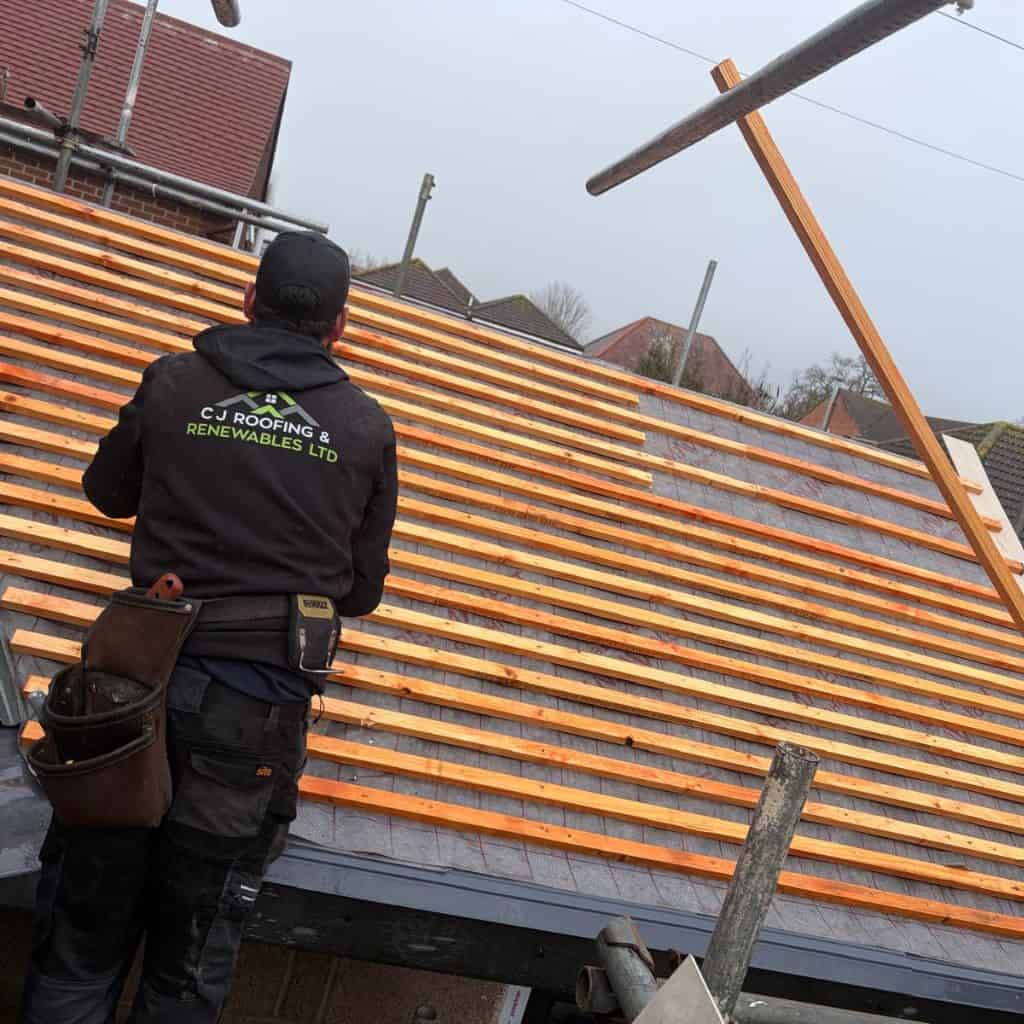
The condition of the battens, underlay and fixings is confirmed across the whole roof only once the tiles are removed. Most of Lymington’s older streets were roofed in slate or clay tile long before the estates behind them, so the two generations fail differently. What the strip-back most frequently reveals across Lymington includes:
Underlay perished beneath sound-looking tiles
The bitumen felt beneath most twentieth-century roofs becomes brittle earlier than the tiles above it, and tears at every lap, admitting water to the battens. A roof inspection from within the loft establishes its condition before any decision to strip and renew.
In Lymington the estates built after former gardens were sold off carry this generation of felt. In the loft we record where the felt has torn from the battens. Where the felt has perished, the battens beneath it are examined along their length.
Fixings crumbled in salt-laden air
On roofs near the coast the strip-back regularly shows nails and clips corroded to a stain in the timber, with the tiles above held only by their own weight. Stripping and refixing the covering restores the fixing across every course, in non-ferrous nails and clips.
Lymington sits on the Solent, and its Georgian and Victorian slate roofs have fixings old enough that this corrosion is common. Slate nails of that age snap at the head, so sound slates are lifted and set aside for reuse.
No underlay beneath the earliest coverings
Roofs of the earliest generation were laid without any underlay, so the slates or tiles are the only barrier between the loft and the weather. A membrane can only be laid where the covering above it is lifted, so a replacement is the point at which every slope receives one.
Lymington’s Georgian and early Victorian houses belong to this generation, their rear outbuildings on the old burgage plots often roofed the same way. The outbuilding roofs receive the same membrane as the house.
Valleys and junctions worn ahead of the slopes
Valleys and chimney junctions convey considerably more water than any part of a slope, so the boards and lead beneath them deteriorate first. Where the strip-back exposes decayed junction timbers, new boards and lead go in as the slopes around them are laid.
Lymington’s older houses carry chimneys built for open fires, and the junctions around them have taken water since the roof was built.
A patchwork of past repairs
Roofs patched by successive contractors carry mismatched tiles, sealants and flashing details, each of a different age. The layers beneath a patch cannot be assessed until it is lifted, so a full strip removes every patch and the roof is relaid in one covering on new battens.
A harbour town accumulates this kind of patchwork, and Lymington’s oldest streets are no exception. Lead soakers and flashings added by earlier repairs are stripped with the covering and renewed in new lead.
How does Lymington housing shape a roof replacement?
Lymington divides between its old town, still roofed largely in slate and clay tile, and the low-rise estates built later on land sold off from the fringes. The old streets typically show thin fixings corroded by salt air and, on the earliest houses, no underlay at all. On the estates the felt and battens have reached the end of their life together, since a whole close was built to one specification.
What goes back on follows the street it sits on. Slate or clay is matched in dimension and colour on the old town roofs, over new non-ferrous fixings and a breathable membrane where none existed. On the estates the tile profile is measured before the new covering is ordered, and each gutter is sized for the roof area it serves.
What does a roof replacement look like day to day in Lymington?
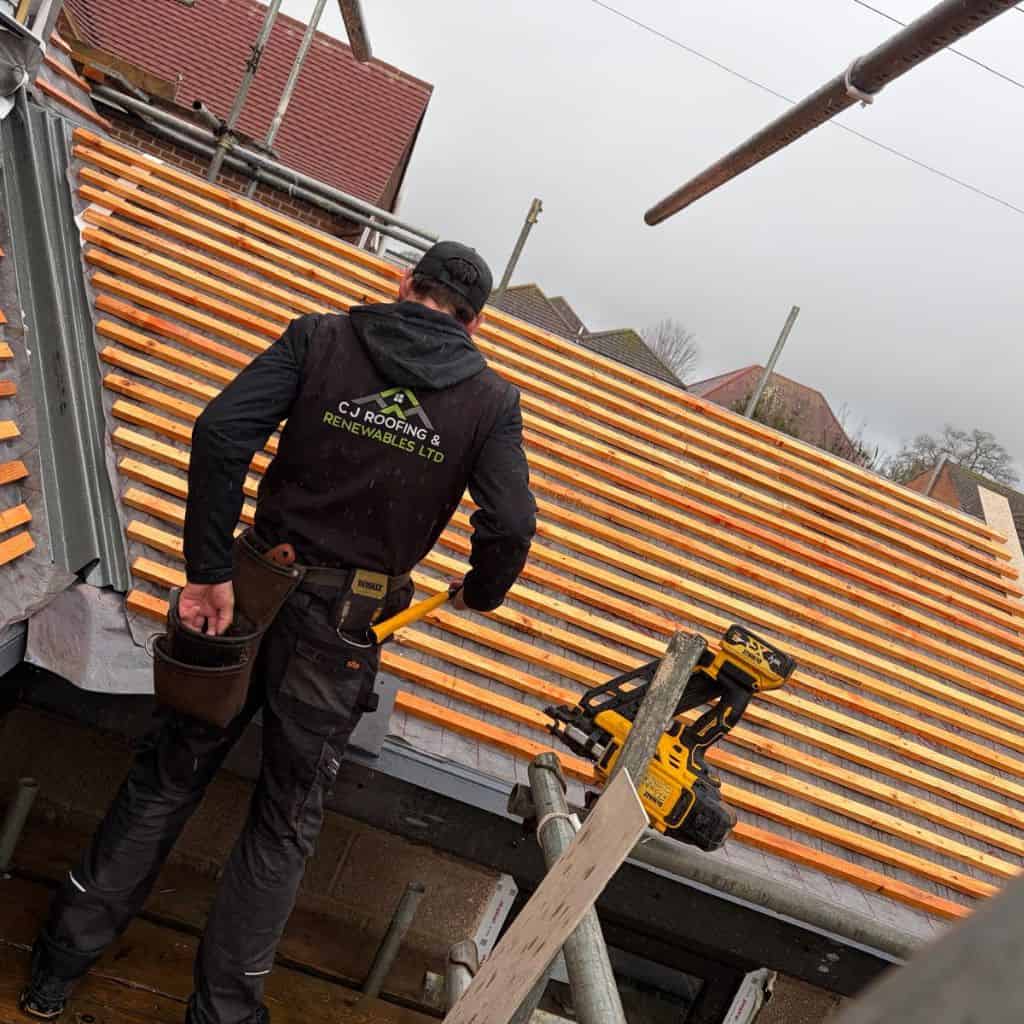
A scaffold, a skip and a working team arrive at your address for the duration. Each stage is scheduled around your household and the morning forecast, and in Lymington the sequence runs as follows:
The days before we start
The scaffold, the skip and the first deliveries of battens, underlay and tile arrive at times and locations agreed beforehand. You move garden furniture and vehicles clear of the working area before the first morning. Our team manages everything else on the schedule.
The pace of the strip
The morning forecast determines how many courses come off, and no more is stripped than new underlay and battens can close by evening. Any section not reached is left weathertight, so the loft and the ceilings beneath it are protected overnight.
Pricing what the strip uncovers
If the strip-back uncovers a rafter, purlin or flashing detail beyond the quote, work there stops until you have seen it and agreed the price. A written note records any further work before it proceeds. No item appears on the final invoice without your approval.
New underlay, battens and tiles in sequence
Underlay, battens, flashings and the new tiles go on in that order, each course lapping the one beneath. Whether the specification is tile roofing or natural slate, each slope is completed and its ridge and verge detailed before the next is started.
The last day
A director walks you round the finished roof from ground level and hands over the written documentation for the work. Our team removes the waste and clears the new gutters, and the scaffold is booked off site once the final check is signed.
Why Choose Us for Roof Replacement in Lymington?
Over 15 years of experience working in Lymington
Connor and Jack bring over 15 years of combined hands-on roofing experience, delivering everything from small domestic repairs to large-scale commercial projects, including roof replacements on Lymington's Georgian and Victorian slate roofs.

Local Lymington knowledge
Based in Portsmouth with deep local roots, we understand Hampshire's homes, weather and building styles, including the corroded coastal fixings a Lymington strip-back exposes, which allows us to deliver roofing work that lasts.
5-star rated service
We are proud to be rated 5 stars on Google by our customers, reflecting the quality of our workmanship and our commitment to reliable, professional service.
Competent & highly trained team
Our team is fully trained and certified in asbestos awareness, working at height and manual handling, ensuring every project is carried out safely and to industry standards.
£5 million public liability insurance
We carry up to £5 million in public liability insurance, giving you complete peace of mind that your property is fully protected while we work in Lymington.
10 year workmanship guarantee
All new roof installations and replacements come with a 10-year workmanship guarantee, so you are covered in the unlikely event of any issues, and a roof repair is quoted where a Lymington roof remains sound.







Frequently asked questions
Take a look at the Frequently Asked Questions regarding our Roof Replacement service in Lymington.
How much does it cost to replace a roof in Lymington?
Four factors determine the cost of a replacement:
- The quantity of tile and batten removed, and its disposal
- Any rafter or batten renewal the strip-back proves necessary
- The dimensions, pitch and complexity of the slopes
- The tiles or slates going back on, over new underlay and fixings
A free survey conducted by a director establishes all four, and your written, itemised quote follows within 48 hours of it, with every item priced and no hidden extras.
Will a replacement roof match the rest of your Lymington street?
Yes, and the match is specified at survey. Lymington’s old town houses were roofed mainly in slate, with clay tile and the occasional hung mathematical tile. The estates behind them were built later in concrete interlocking tile. A replacement on either matches like for like. Slate roofing goes back in the same dimension and colour, or clay tile to the original gauge and ridge detail. On the estates the profile is measured before any tile is ordered.
Do you need planning permission to replace a roof in Lymington?
In most cases, no. Where the new roof is similar in appearance to the one it replaces, a like-for-like replacement is normally permitted development and no application is necessary. A listed building is the exception, and consent is required before the covering or the chimney stack details change. Controls in a conservation area differ from one designation to the next, and a change of covering can require consent. We establish which applies at survey, and the quote accounts for it before any work begins.
Is it worth replacing the roof on an older Lymington home?
On an older property it generally is. The Georgian and Victorian houses that make up much of Lymington’s old town carry roofs at the age where individual repairs begin to recur. A replacement adds the layers absent from a roof of that generation, including a breathable roof underlay, mechanically fixed tiles and a ventilated ridge. The fixings then meet current standards across every slope, and the loft has a ventilation path.
How do I arrange a roof replacement quote in Lymington?
Contact us by telephone or through the enquiry form on this website. The free survey is conducted by a director at a time convenient to you, covering the eaves, flashings and loft interior. If the roof retains serviceable life, we recommend a repair and quote for that instead. Otherwise your written, itemised quote for the replacement follows within 48 hours of the visit. We cover the whole of our Lymington service area.
The Lymington Suburbs we Provide Roof Replacement services to:
Buckland, Lower Buckland, Lower Pennington, Lymington Town, Normandy, Pennington, Pennington Village, Upper Pennington, Waterford, Woodside.
Our services in Lymington
Our Roof Replacement services near Lymington
About Lymington
Lymington
About LymingtonWalhampton School Location Walhampton
Lymington,
Hampshire,
SO41 5ZGEnglandCoordinates 50°46′07″N 1°31′53″W / 50.7685°N 1.5313°W Information Type Preparatory school
Day & BoardingReligious affiliationChurch of England Department for Education URN116525 Tables HeadmasterJonny Timms Gender Coeducational Age 2 to 13 Enrolment 330~ Colour Blue Website http://www.walhampton.com Walhampton School is a coeducational private preparatory school situated in the hamlet of Walhampton, near Lymington, England. It is the result of the 1997 merger between Hordle House School, situated in Milford on Sea, and Walhampton School, which was based at the current site. The merged school was known as ’Hordle Walhampton’ until 2013, when it reverted to its previous name of ‘Walhampton School’.
The Walhampton School was founded in 1948 by Mrs Audrey Brewer, who purchased the house and grounds from the Morrison family. In 1954 Brewer sold the school to John Bradfield who subsequently converted the enterprise into a charitable trust.
Hordle House School was founded in 1926 by the Reverend Ernest Whately-Smith, MC.
The school has approximately 400 children aged between 2 and 13.
Featured Business LocationC J Roofing & Renewables Ltd near Lymington
roofing contractor, service, establishment
5 stars (16 reviews)Phone: 023 9387 3756Things To Do in Lymington (30)
Points of Interest Near Lymington (30)
Landmarks & Leisure Near Lymington (30)
Nearby Suburbs