Tile Roofing Lymington
Tile Roofing services in Lymington
A tile roof is renewed as a whole, so the tile you choose governs the appearance of the whole elevation. It also governs what we renew beneath it: the battens, the underlay, and the ridge and verge junctions. Lymington properties carry roofs of several generations, from the handmade clay tile and slate of the Georgian and Victorian houses to the concrete interlocking of the post-war estates and the current ranges on recent infill.
A director conducts your survey, backed by over 15 years of combined hands-on experience, a 5-star rated reputation and £5 million of public liability insurance. We respond within 48 hours. Your written, itemised quotation names the tile schedule and the price with no hidden extras.
Which tile roofing jobs do Lymington homeowners ask us about?
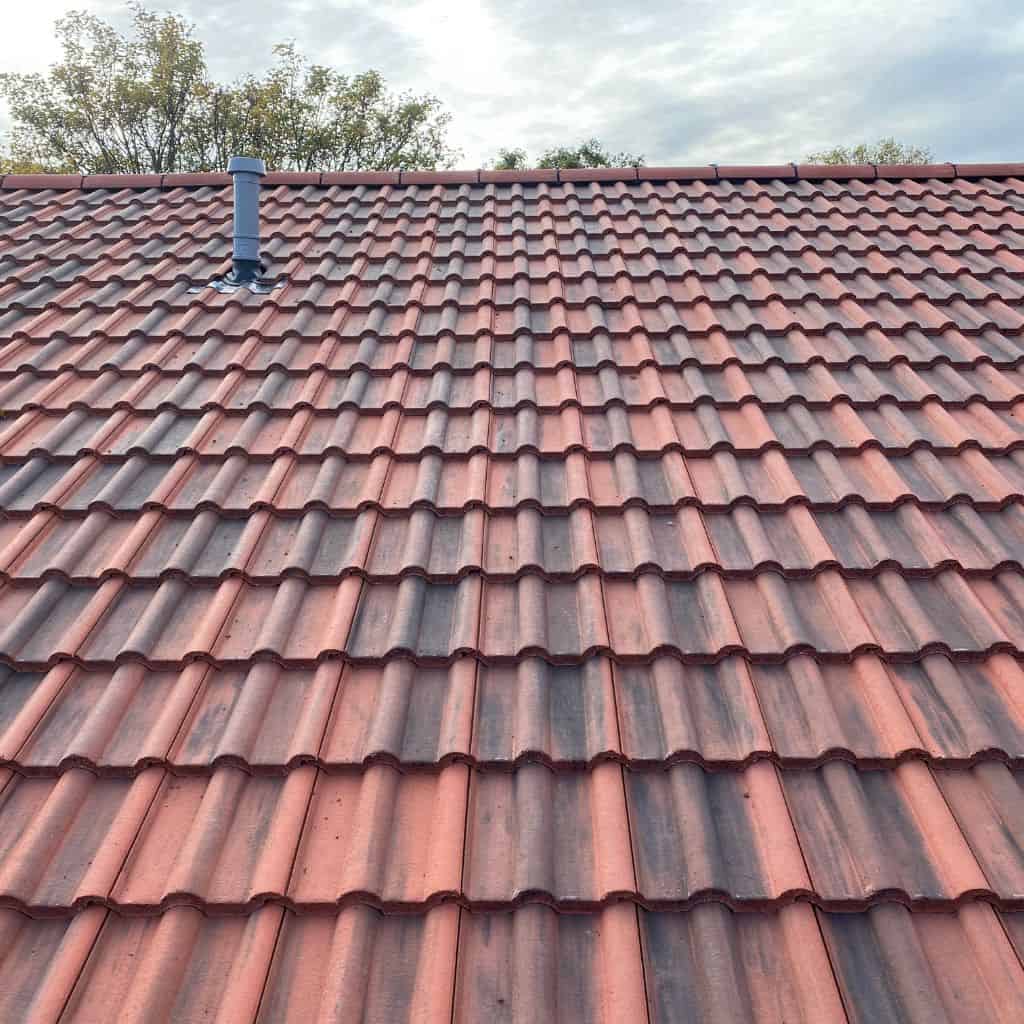
Three generations of tile sit on the roofs of Lymington: handmade clay and slate in the older town, concrete interlocking across the post-war estates, and one current range on the three-storey infill of recent years. These are the tile roofing jobs Lymington homeowners ask us about most often:
Tiles that could be re-laid rather than replaced
Where a roof is stripped, we sort the tiles that come off and retain any that are sound for re-laying. Salvageable clay and concrete tiles are frequently re-laid on replacement battens and fresh underlay, with only the broken proportion made up from matching stock. A director establishes the salvageable quantity at survey.
The handmade clay tiles on Lymington’s Georgian and Victorian houses are sorted with particular care, because current ranges do not always match them.
A choice between tile and slate on the same roof
Both materials are appropriate on Hampshire properties. The pitch, the capacity of the rafters beneath, and the profiles already on the elevation determine the choice. We price slate roofing alongside the tile wherever either material is appropriate, so the comparison is made on figures.
Handmade clay tile and slate stand on neighbouring Georgian and Victorian houses in Lymington, so a director measures the pitch and the rafters before either material is priced.
Repairs that have reached the end of what they can achieve
Individual repairs remain appropriate until the roof as a whole reaches the same condition. After that point each repair refixes tiles onto battens as fatigued as the ones beside them. The next step is re-tiling the slope or a full roof replacement, and a director confirms which the property requires at survey.
On Lymington’s seaward elevations the battens have weathered alongside the tiles above them, so a refixed tile seldom holds.
A property being prepared for sale or letting
A roof is among the first elements a surveyor reports on, and an unresolved one is negotiated against the asking price. Re-tiling beforehand removes it from that discussion, and the ridge, verge and flashing details are documented with the rest of the quotation.
Owners selling Lymington’s Georgian and Victorian houses ask for this most often, because a buyer’s surveyor checks the handmade clay tile and the slate for slipped and delaminated units.
A ridge and verge detail to be settled at the same time
A re-tile is the point at which the ridge and verge specification is decided, because the team re-forms both junctions once the tiles are off. Dry-fixed systems remove bedded mortar from those junctions, and where the loft beneath requires ventilation, ridge vent installation is fitted within the same run.
South-westerly gales drive rain onto the exposed verges of Lymington houses, and the bedded mortar on those junctions cracks and washes out first.
What kind of tile roofs do Lymington properties have?
Georgian and Victorian houses make up the older part of Lymington. Their roofs carry handmade clay tile and slate, with tile hanging and mathematical tiles on some elevations. The pitches are steep, and the plots run long and narrow behind a modest frontage.
Low-rise estates followed on the land released after the Second World War, and those roofs carry concrete interlocking tiles to one profile across whole streets. The three-storey infill built more recently stands on plots that once held a single house, with dormers and hipped slopes above.
A re-tile in Lymington matches a handmade clay elevation, a slated one or an estate profile, and a director establishes which of the three at the survey before any tile is ordered. The team reaches the estate roofs from each plot’s driveway, and the older houses from a narrow frontage. Those older plots run back from the street as long, narrow strips with outbuildings behind, so the rear slopes are reached through the plot and the tiles are carried in by hand. The seaward slopes above the quay take driven rain off the Solent, so the ridge and verge mortar on those elevations fails first.
What is it like to have a tile roof fitted in Lymington?
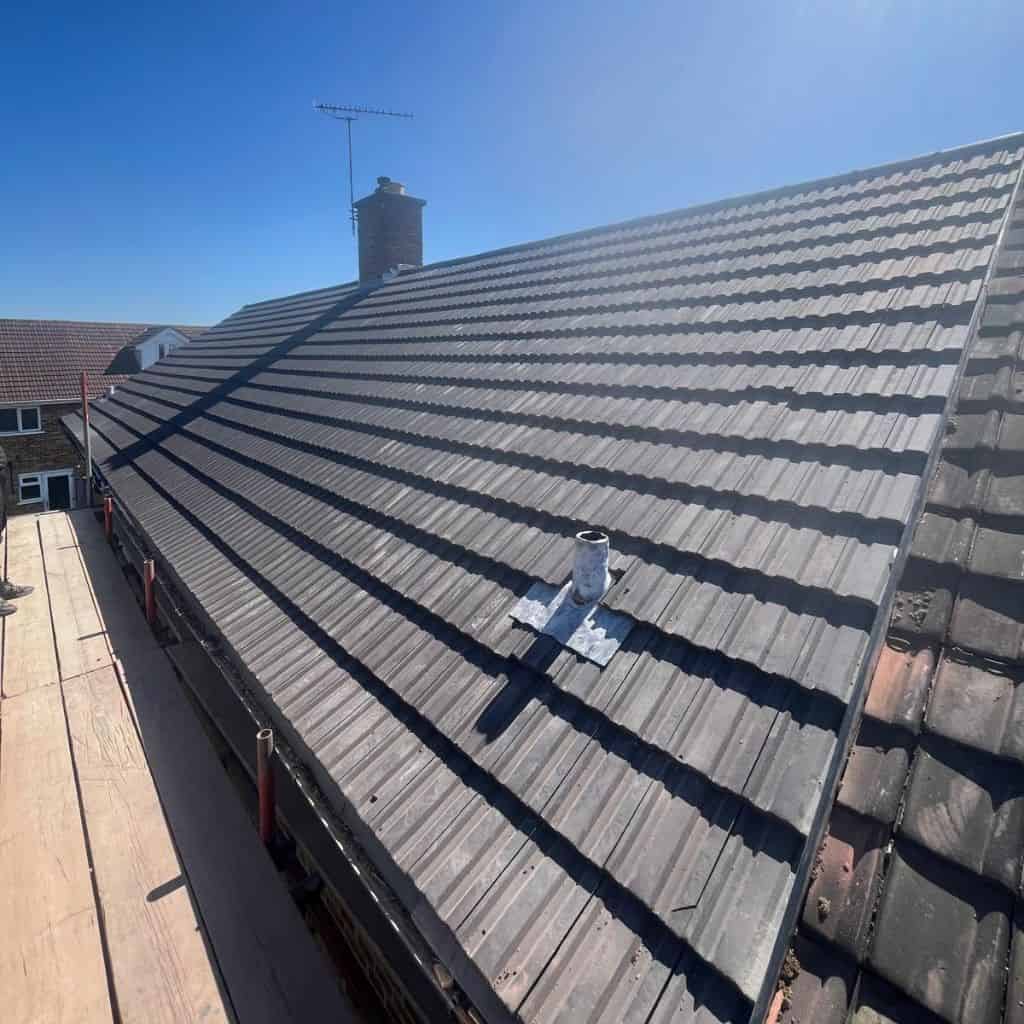
A tile roof is renewed as a whole, so the quotation names what is fitted beneath the tiles as well as the tiles themselves. This is how the team installs a tile roof on a Lymington property, from survey to handover.
A director surveys the roof before anything is priced
The first visit establishes which tile the elevation carries, the condition of the battens and underlay beneath it, and the capacity of the rafters. Where the question concerns the condition of an existing roof rather than its renewal, a roof inspection answers it first.
The tile and the fixings named in the written quotation
Within 48 hours you receive an itemised quotation naming the tile, the underlay, the battens and the ridge and verge junctions. Labour and waste removal are priced separately. There is no obligation and there are no hidden extras: the price you accept is the price you pay.
The property protected before the tiles come off
The access equipment stands clear of the driveway and the planting, and the ground beneath the eaves is sheeted. Deliveries are timed so that pallets do not stand longer than necessary, and anything stored in the loft is protected before the strip begins.
Our own team on the roof from eaves to ridge
Our own team carries out the installation throughout, with no subcontracted labour. A director oversees the project and remains your single point of contact. The same schedule is followed on every slope, so the finished roof is consistent from eaves to ridge.
Handover, spare tiles and the written record
The team clears the gutters and valleys of debris from the installation and leaves the property as it was found. Surplus tiles from the same delivery remain with the household, and the documentation of the materials fitted is issued with the invoice.
Why Choose Us for Tile Roofing in Lymington?
Over 15 years of experience working in Lymington
Connor and Jack bring over 15 years of combined hands-on roofing experience, delivering everything from small domestic repairs to large-scale commercial projects on Lymington's handmade clay tile and slate roofs, including new roof installation.

Local Lymington knowledge
Based in Portsmouth with deep local roots, we understand Hampshire's homes, weather and building styles, including Lymington's Solent-facing roofs, where we specify a dry-fixed ridge, which allows us to deliver roofing work that lasts.
5-star rated service
We are proud to be rated 5 stars on Google by our customers, reflecting the quality of our workmanship and our commitment to reliable, professional service.
Competent & highly trained team
Our team is fully trained and certified in asbestos awareness, working at height and manual handling, ensuring every project is carried out safely and to industry standards.
£5 million public liability insurance
We carry up to £5 million in public liability insurance, giving you complete peace of mind that your property is fully protected while we work in Lymington.
10 year workmanship guarantee
All new tile roof installations come with a 10-year workmanship guarantee, so you are covered in the unlikely event of any issues.







Frequently asked questions
Take a look at the Frequently Asked Questions regarding our Tile Roofing service in Lymington.
Can you re-tile one slope of a Lymington roof?
Yes. The request is most common where one elevation has been patched repeatedly or is more exposed to driven rain than the others. The decision rests on whether the remaining slopes have reached the same condition. Where they have, re-tiling them in the same visit costs less than returning separately. Where they have not, we leave the serviceable slopes undisturbed. We then form the hip, ridge or valley junction so that the two generations of tile meet properly.
What happens to the old tiles and the waste in Lymington?
We remove everything stripped from the elevation. Salvageable tiles are set aside for re-laying or left with you, and the remainder is taken away. The property is swept at completion, and the skip is collected once the installation is finished. In the older town the frontages are narrow and the plots run back behind them, while the post-war estates gave each plot a driveway. Where nowhere on the plot will accommodate a skip, we agree the position before the installation is booked.
Does re-tiling a Lymington roof need scaffolding?
Yes for anything above single storey. A full roof means loaded pallets, edge protection and the team working at the eaves and at the ridge. No ladder can support that safely. We price scaffolding within the itemised quotation rather than adding it afterwards. Where a bungalow slope or a low outbuilding is reachable from a tower instead, the quotation names the tower and prices it accordingly.
What is renewed beneath the tiles in Lymington?
The battens and the roof underlay are renewed with the tiles. A director assesses the lead at the abutments and the valleys and allows for it within the quotation. Lymington roofs range from Georgian and Victorian clay tile and slate on the original rafters to estate roofs on their first underlay. We will not quote for new tiles over battens or rafters that have reached the end of their service life.
Where does a tile roofing project begin in Lymington?
With a telephone call or the contact form. A director attends to survey the roof, measure the slopes and establish what lies beneath the tiles. The written, itemised quotation follows within 48 hours, and the installation is booked for a time that suits the household. That is the same wherever you are across our Lymington service area.
The Lymington Suburbs we Provide Tile Roofing services to:
Buckland, Lower Buckland, Lower Pennington, Lymington Town, Normandy, Pennington, Pennington Village, Upper Pennington, Waterford, Woodside.
Our services in Lymington
Our Tile Roofing services near Lymington
About Lymington
Lymington
About LymingtonWalhampton School Location Walhampton
Lymington,
Hampshire,
SO41 5ZGEnglandCoordinates 50°46′07″N 1°31′53″W / 50.7685°N 1.5313°W Information Type Preparatory school
Day & BoardingReligious affiliationChurch of England Department for Education URN116525 Tables HeadmasterJonny Timms Gender Coeducational Age 2 to 13 Enrolment 330~ Colour Blue Website http://www.walhampton.com Walhampton School is a coeducational private preparatory school situated in the hamlet of Walhampton, near Lymington, England. It is the result of the 1997 merger between Hordle House School, situated in Milford on Sea, and Walhampton School, which was based at the current site. The merged school was known as ’Hordle Walhampton’ until 2013, when it reverted to its previous name of ‘Walhampton School’.
The Walhampton School was founded in 1948 by Mrs Audrey Brewer, who purchased the house and grounds from the Morrison family. In 1954 Brewer sold the school to John Bradfield who subsequently converted the enterprise into a charitable trust.
Hordle House School was founded in 1926 by the Reverend Ernest Whately-Smith, MC.
The school has approximately 400 children aged between 2 and 13.
Featured Business LocationC J Roofing & Renewables Ltd near Lymington
roofing contractor, service, establishment
5 stars (16 reviews)Phone: 023 9387 3756Things To Do in Lymington (30)
Points of Interest Near Lymington (30)
Landmarks & Leisure Near Lymington (30)
Nearby Suburbs