
Tile Roofing Portsmouth
Tile Roofing services in Portsmouth
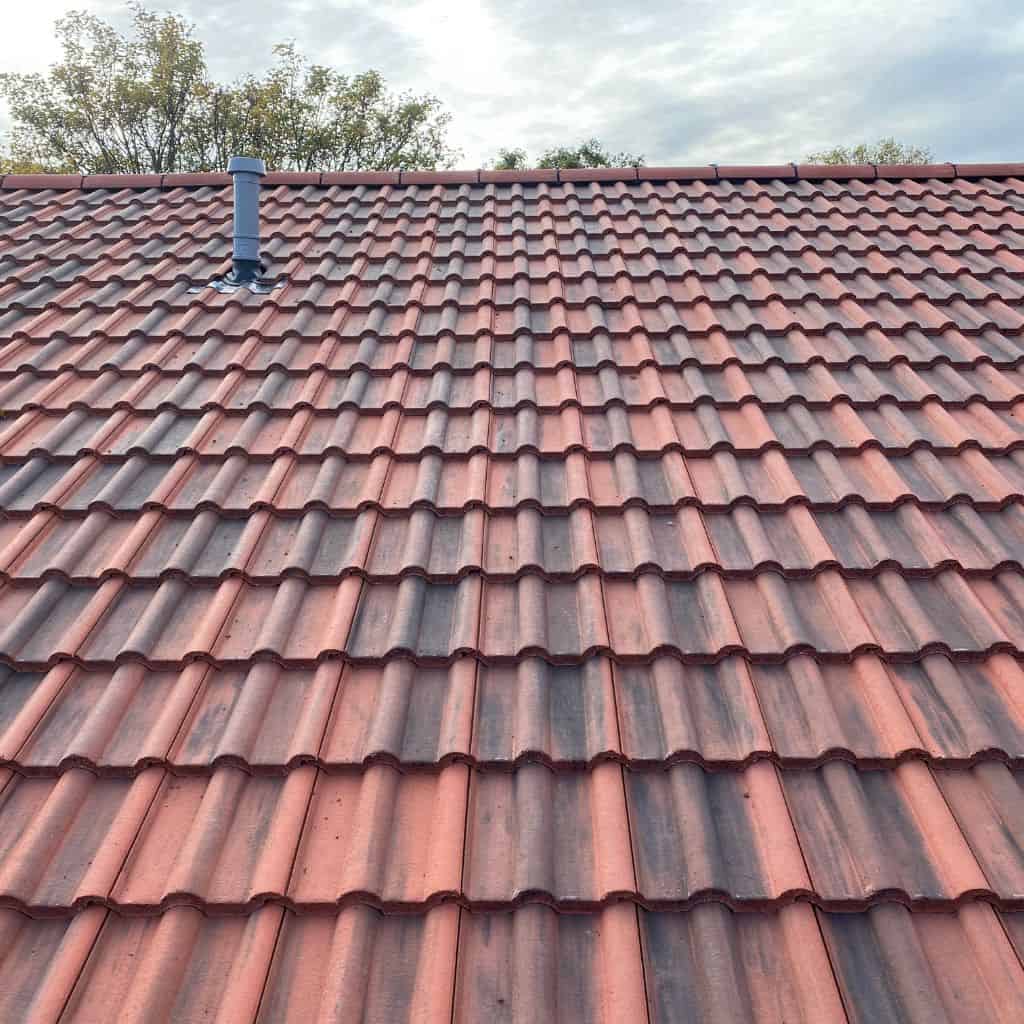
A tile roof is renewed as a whole, so the tile you choose governs the appearance of the whole elevation. It also governs what we renew beneath it: the battens, the underlay, and the ridge and verge junctions. Portsmouth properties sit at opposite ends of that range. The Victorian and Edwardian terraces of Southsea and Fratton carry slate finished with clay ridge tiles. The post-war estate housing further north at Paulsgrove and Wymering carries concrete interlocking tile.
A director conducts your survey, backed by over 15 years of combined hands-on experience, a 5-star rated reputation and £5 million of public liability insurance. We respond within 48 hours. Your written, itemised quotation names the tile schedule and the price with no hidden extras.
Which tile roofing jobs do Portsmouth homeowners ask us about?
Portsmouth roofs were covered in two broad eras. Slate covers the Victorian and Edwardian terraces of Southsea and Fratton, and concrete interlocking tile covers the estate housing at Paulsgrove and the later rebuilding that replaced whole terraced streets. These are the tile roofing jobs Portsmouth homeowners ask us about most often:
Tiles that could be re-laid rather than replaced
Where a roof is stripped, we sort the tiles that come off and retain any that are sound for re-laying. Salvageable clay and concrete tiles are frequently re-laid on replacement battens and fresh underlay, with only the broken proportion made up from matching stock. A director establishes the salvageable quantity at survey.
Slate on the Portsmouth terraces usually fails at the corroded nail, so the team lifts intact slates whole and sets them aside for re-laying.
Repairs that have reached the end of what they can achieve
Individual repairs remain appropriate until the roof as a whole reaches the same condition. After that point each repair refixes tiles onto battens as fatigued as the ones beside them. The next step is re-tiling the slope or a full roof replacement, and a director confirms which the property requires at survey.
Previous installers have patched many Portsmouth terraces slope by slope, and the battens beneath now match the tiles in age.
A choice between tile and slate on the same roof
Both materials are appropriate on Hampshire properties. The pitch, the capacity of the rafters beneath, and the profiles already on the elevation determine the choice. We price slate roofing alongside the tile wherever either material is appropriate, so the comparison is made on figures.
Slate covers the older Portsmouth terraces, and tile sits on the estate housing behind them, often within one street.
A ridge and verge detail to be settled at the same time
A re-tile is the point at which the ridge and verge specification is decided, because the team re-forms both junctions once the tiles are off. Dry-fixed systems remove bedded mortar from those junctions, and where the loft beneath requires ventilation, ridge vent installation is fitted within the same run.
Salt-laden air off the harbours erodes the bedded mortar on exposed Portsmouth ridges, so a dry-fixed ridge lasts considerably longer there.
A change of tile appearance on a re-tile
A re-tile is the one occasion on which the colour or profile of a roof can change, and the replacement tile also has to suit the pitch and the batten gauge beneath it. Where consent is required before the appearance changes, a director confirms that at survey rather than after ordering.
Portsmouth terraces run in long unbroken slopes, so a tile of a different colour is conspicuous along the whole row.
What kind of tile roofs do Portsmouth properties have?
Victorian and Edwardian terraces make up much of Portsea Island. The builders roofed them in long unbroken runs of slate, finished with clay ridge tiles and gabled or hipped ends. Bay windows carry their own small slopes, and rear additions bring valleys and abutments into otherwise simple roofs.
Builders laid out estate housing at Paulsgrove and Wymering after the war, and further rebuilding replaced whole terraced streets during the 1960s and 1970s. Those roofs carry concrete interlocking tile, one profile to a street, over shallower slopes than the terraces.
A re-tile in Portsmouth matches one of those two generations, the slate of the terraces or the concrete of the estates, and a director confirms the tile at survey. Terraced frontages leave no side passage, so the team reaches most of these roofs from the pavement. A director agrees the scaffold position with you before the work is booked.
What is it like to have a tile roof fitted in Portsmouth?
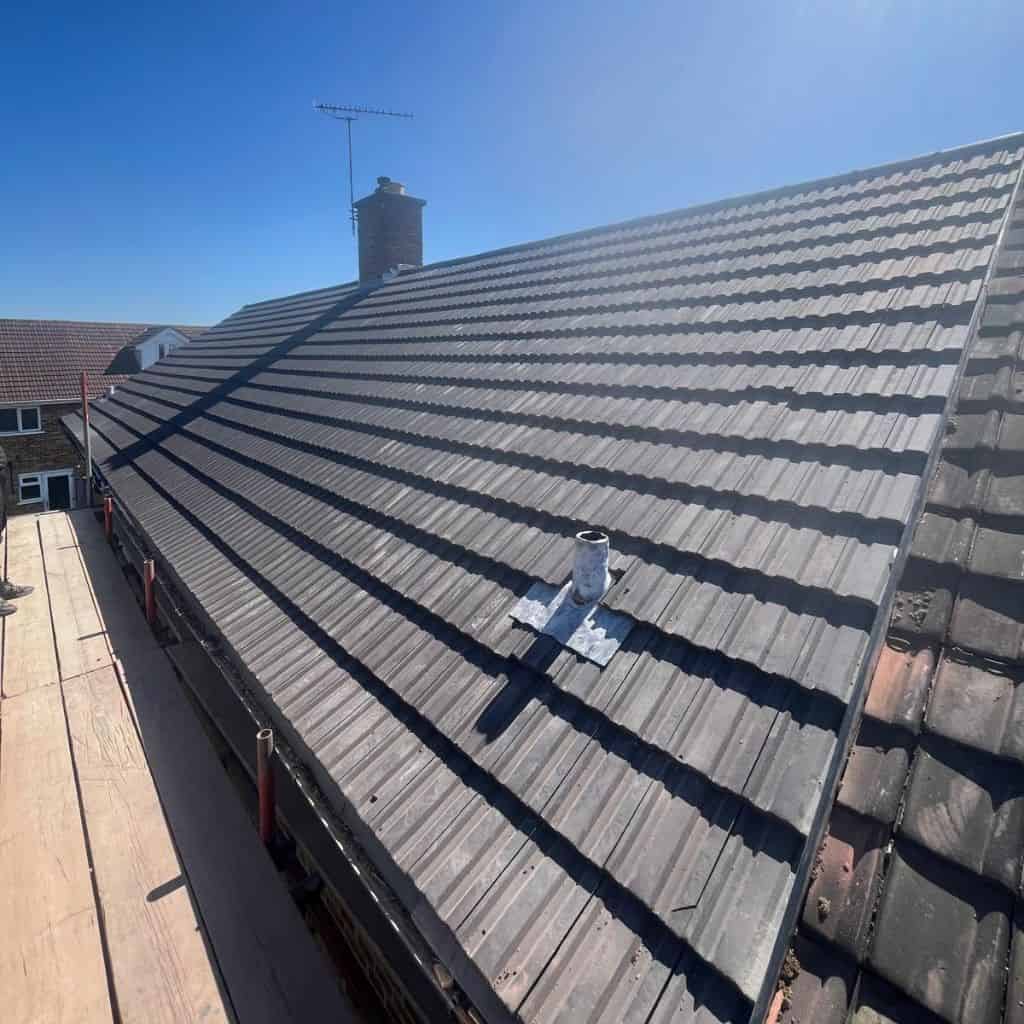
A tile roof is renewed as a whole, so the quotation names what is fitted beneath the tiles as well as the tiles themselves. This is how the team installs a tile roof on a Portsmouth property, from survey to handover.
A director surveys the roof before anything is priced
The first visit establishes which tile the elevation carries, the condition of the battens and underlay beneath it, and the capacity of the rafters. Where the question concerns the condition of an existing roof rather than its renewal, a roof inspection answers it first.
The tile and the fixings named in the written quotation
Within 48 hours you receive an itemised quotation naming the tile, the underlay, the battens and the ridge and verge junctions. Labour and waste removal are priced separately. There is no obligation and there are no hidden extras: the price you accept is the price you pay.
The property protected before the tiles come off
The access equipment stands clear of the driveway and the planting, and the ground beneath the eaves is sheeted. Deliveries are timed so that pallets do not stand longer than necessary, and anything stored in the loft is protected before the strip begins.
Our own team on the roof from eaves to ridge
Our own team carries out the installation throughout, with no subcontracted labour. A director oversees the project and remains your single point of contact. The same schedule is followed on every slope, so the finished roof is consistent from eaves to ridge.
Handover, spare tiles and the written record
The team clears the gutters and valleys of debris from the installation and leaves the property as it was found. Surplus tiles from the same delivery remain with the household, and the documentation of the materials fitted is issued with the invoice.
Why Choose Us for Tile Roofing in Portsmouth?
Over 15 years of experience working in Portsmouth
Connor and Jack bring over 15 years of combined hands-on roofing experience, delivering everything from small domestic repairs to large-scale commercial projects on Portsmouth's slate terraces and post-war concrete estates, including new roof installation.

Local Portsmouth knowledge
Based in Portsmouth with deep local roots, we understand Hampshire's homes, weather and building styles, including Portsmouth's salt-exposed terraced roofs, where ridge tiles are mechanically clipped, which allows us to deliver roofing work that lasts.
5-star rated service
We are proud to be rated 5 stars on Google by our customers, reflecting the quality of our workmanship and our commitment to reliable, professional service.
Competent & highly trained team
Our team is fully trained and certified in asbestos awareness, working at height and manual handling, ensuring every project is carried out safely and to industry standards.
£5 million public liability insurance
We carry up to £5 million in public liability insurance, giving you complete peace of mind that your property is fully protected while we work in Portsmouth.
10 year workmanship guarantee
All new tile roof installations come with a 10-year workmanship guarantee, so you are covered in the unlikely event of any issues.







Frequently asked questions
Take a look at the Frequently Asked Questions regarding our Tile Roofing service in Portsmouth.
Can you re-tile one slope of a Portsmouth roof?
Yes. The request is most common where one elevation has been patched repeatedly or is more exposed to driven rain than the others. The decision rests on whether the remaining slopes have reached the same condition. Where they have, re-tiling them in the same visit costs less than returning separately. Where they have not, we leave the serviceable slopes undisturbed. We then form the hip, ridge or valley junction so that the two generations of tile meet properly.
What happens to the old tiles and the waste in Portsmouth?
We remove everything stripped from the elevation. Salvageable tiles are set aside for re-laying or left with you, and the remainder is taken away. The property is swept at completion, and the skip is collected once the installation is finished. Few Portsmouth terraces have a driveway, and parked cars line both sides of the street. Where nowhere on the plot will accommodate a skip, we agree the position before the installation is booked.
Does re-tiling a Portsmouth roof need scaffolding?
Yes for anything above single storey. A full roof means loaded pallets, edge protection and the team working at the eaves and at the ridge. No ladder can support that safely. We price scaffolding within the itemised quotation rather than adding it afterwards. Where a bungalow slope or a low outbuilding is reachable from a tower instead, the quotation names the tower and prices it accordingly.
What is renewed beneath the tiles in Portsmouth?
The battens and the roof underlay are renewed with the tiles. A director assesses the lead at the abutments and the valleys and allows for it within the quotation. Portsmouth stock ranges from Victorian terraces with slate on battens with no underlay beneath to post-war estate roofs still on their original felt. Where the post-war felt has become brittle, the team strips it with the battens and lays breathable underlay in its place. We will not quote for new tiles over battens or rafters that have reached the end of their service life.
Where does a tile roofing project begin in Portsmouth?
With a telephone call or the contact form. A director attends to survey the roof, measure the slopes and establish what lies beneath the tiles. The written, itemised quotation follows within 48 hours, and the installation is booked for a time that suits the household. That is the same wherever you are across our Portsmouth service area.
The Portsmouth Suburbs we Provide Tile Roofing services to:
Baffins, Buckland, Copnor, Cosham, Drayton, Eastney, Farlington, Fratton, Hilsea, Kingston, Landport, Milton, North End, Old Portsmouth, Paulsgrove, Portsea, Rudmore, Somerstown, Southsea, Stamshaw, Tipner, Wymering.
Our services in Portsmouth
Our Tile Roofing services near Portsmouth
About Portsmouth
Portsmouth
About PortsmouthPortsmouthCity & unitary authority areaPortsmouth Harbour, including Spinnaker TowerThe GuildhallSouthsea BeachHMS VictoryMary Rose MuseumGunwharf QuaysClarence PierFlagCoat of ArmsNickname: PompeyMotto: Heaven’s Light Our GuideShown within HampshirePortsmouthLocation within the United KingdomCoordinates: 50°48′21″N 01°05′14″W / 50.80583°N 1.08722°W Sovereign state United Kingdom Country England Region South East England Ceremonial county Hampshire Government • Type Unitary authority, city • Governing body Portsmouth City Council • Leadership Leader and Cabinet (Liberal Democrats) • Lord Mayor Abdul Kadir • Members of Parliament Stephen Morgan (L)
Amanda Martin (L)[2]Area • City & unitary authority area15.54 sq mi (40.25 km2) Population (2011, 2021)• City & unitary authority area208,100[1][a] • Urban 238,137[4][c] • Metro 855,679 (South Hampshire)[3][b] Ethnicity (2021) [5]• Ethnic groups List- 85.2% White
- 6.9% Asian
- 3.4% Black
- 2.6% Mixed
- 1.8% other
Religion (2021) [5]• Religion List- 47.1% no religion
- 39.4% Christianity
- 6.4% not stated
- 4.9% Islam
- 0.8% Hinduism
- 0.6% other
- 0.5% Buddhism
- 0.2% Sikhism
- 0.1% Judaism
Time zone UTC+0 (GMT) • Summer (DST) UTC+1 (BST) Postal code POArea code 023 ISO 3166 code GB-POR Police Hampshire and Isle of Wight Ambulance South Central Fire Hampshire and Isle of Wight Website portsmouth .gov .uk Portsmouth (/ˈpɔːrtsməθ/ ⓘ PORTS-məth) is a port city and unitary authority in Hampshire, England. Most of Portsmouth is located on Portsea Island, off the south coast of England in the Solent, making Portsmouth the only city in England not located primarily on the mainland. The city is located 22 miles (35 km) south-east of Southampton, 50 miles (80 km) west of Brighton and Hove and 74 miles (119 km) south-west of London. With a population last recorded at 208,100, it is the most densely populated city in the United Kingdom. Portsmouth forms part of the South Hampshire urban area with Gosport, Fareham, Havant, Eastleigh and Southampton.
Portsmouth’s history can be traced to Roman times and it has contained a significant Royal Navy dockyard and base for centuries. Portsmouth was founded c. 1180 by Anglo-Norman merchant Jean de Gisors in the south-west area of Portsea Island, a location now known as Old Portsmouth. Around this time, de Gisors ordered the construction of a chapel dedicated to St Thomas Becket. This became a parish church by the 14th century. Portsmouth was established as a town with a royal charter on 2 May 1194. The city is home to the first drydock ever built. It was constructed by Henry VII in 1496.
Portsmouth has the world’s oldest dry dock currently in use, “The Great Stone Dock”; originally built in 1698, rebuilt in 1769 and presently known as “No.5 Dock”. The world’s first mass production line was established at the naval base’s Block Mills which produced pulley blocks for the Royal Navy. By the early-19th century, Portsmouth was the most heavily fortified city in the world, and was considered “the world’s greatest naval port” at the height of the British Empire throughout Pax Britannica. By 1859, a ring of defensive land and sea forts, known as the Palmerston Forts, had been built around Portsmouth in anticipation of an invasion from continental Europe.
In the 20th century, Portsmouth achieved city status on 21 April 1926. During the Second World War, the city was bombed extensively in the Portsmouth Blitz, which resulted in the deaths of 930 people, and it was a pivotal embarkation point for the D-Day landings. In 1982, a British task force departed from Portsmouth to serve in the Falklands War. HMY Britannia was formerly based in Portsmouth and oversaw the transfer of Hong Kong in 1997, after which Britannia was retired from royal service, decommissioned and relocated to Leith as a museum ship.
Featured Business LocationC J Roofing & Renewables Ltd near Portsmouth
roofing contractor, service, establishment
5 stars (16 reviews)Phone: 023 9387 3756Nearby Suburbs