
Slate Roofing Portsmouth
Slate Roofing services in Portsmouth
A slate roof is stripped and reinstated as a whole. Most of the slate removed from a Portsmouth roof is reinstated on the same slope. The battens, the underlay, the fixings and the lead beneath the covering therefore account for most of the price. Portsmouth’s slate belongs to the city’s Victorian terraces and to the late-Georgian and early-Victorian properties at Southsea, including the villas laid out there from the 1830s. The city’s post-war council estates and the developments added since were roofed in tile.
A director conducts your survey and establishes what proportion of the original slate remains serviceable. We respond within 48 hours. Your written, itemised quotation follows within 48 hours of that survey, naming the retained slate, the new slate, the battens, the underlay and the lead, with no hidden extras. The team carries £5 million in public liability insurance and a 5-star rating, and over 15 years of combined hands-on experience stands behind the installation.
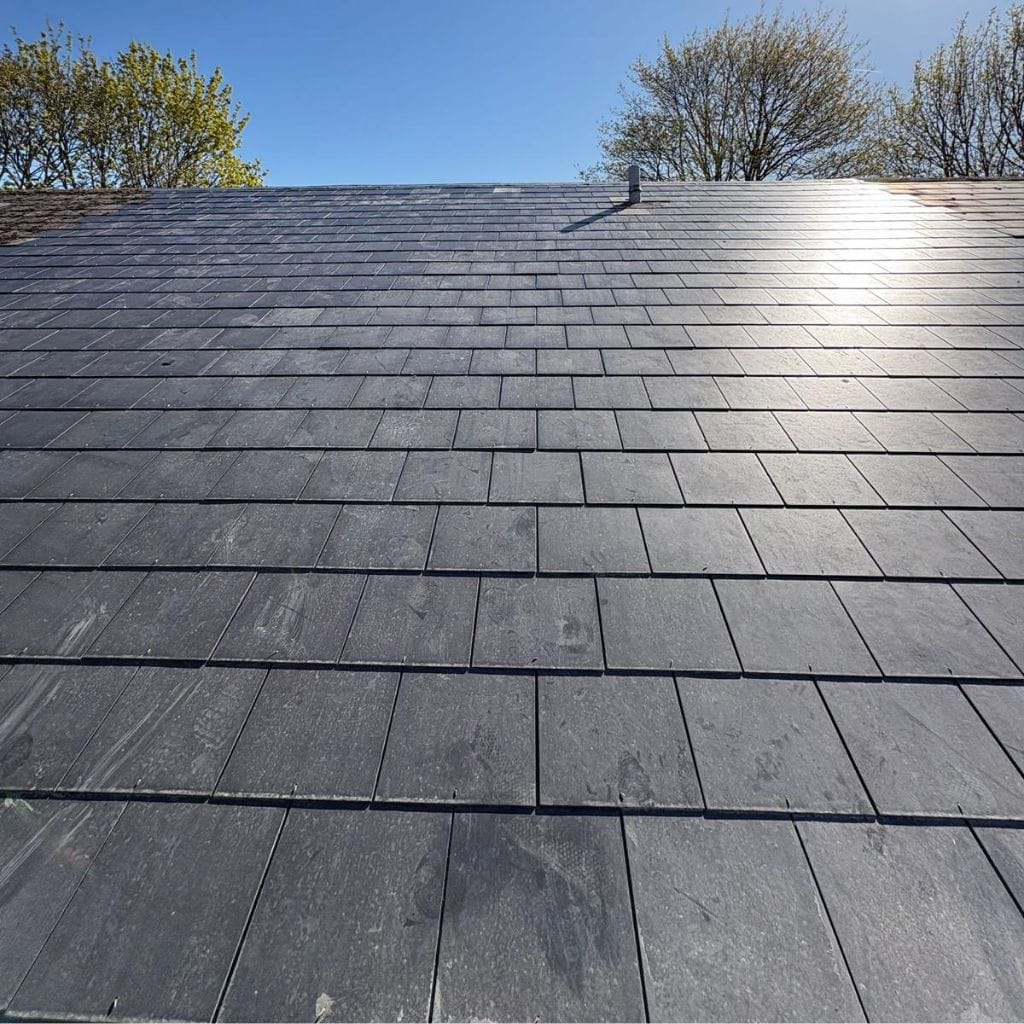
What do Portsmouth homeowners want settled before a slate roof is priced?
Portsmouth’s Victorian terraces carry the city’s slate, and the estates raised after them were tiled from the outset. Homeowners on those terraces want the following settled before a director prices the work:
Refixing that has become routine
Where we are refixing slates season after season, the fixings have reached the end of their service life and the slate has not. Refixing remains appropriate until enough of the elevation is loose that returning costs more than renewing. A director confirms whether the roof needs a roof replacement instead.
A Portsmouth terrace roof is reached from the street, so each return visit requires the access equipment again. A director records how many returns the elevation is likely to need.
What is renewed underneath while the slope is open
Battens and roof underlay sit under the slate and reach the end of their service life first. We renew both while the slope is open, because reaching them later means lifting the slate a second time. The quotation names each of them.
Portsmouth’s surviving Victorian terraces were repaired in phases through the post-war decades, so a director records at survey which battens are original and which belong to that later work.
Lead at the chimney, the abutment and the valley
We reach the lead properly only while the slate around it is off, so we settle it within the same visit. We measure the lead at every chimney, abutment and valley during the survey, and the quotation itemises it separately.
The villas developed at Southsea from the 1830s were built with more elaborate stacks than the terraces beside them, so several abutments can sit on one slope there.
Gutters, fascias and the eaves course together
We work the eaves course, the fascia and the gutter line from the same scaffold, and the eaves is where a slate roof is most often disturbed. Renewing them in one visit avoids a second visit to the same run, and the quotation prices each item separately.
A Portsmouth terrace frontage usually accommodates one scaffold position, and where that frontage meets the pavement the team sheets the footway before the gutter line is lifted.
A choice between staying with slate and moving to tile
A slate roof carries its covering for a generation, so a director settles the choice at the survey. Slate keeps the thin profile and the shadow lines the elevation was built with, and tile roofing changes both. We price both materials for the same roof, so you decide on the quotation.
The post-war estates across the city were roofed in tile, so the two coverings are found within a few streets of each other.
Which Portsmouth roofs were built for slate?
Portsmouth’s housing is overwhelmingly Victorian, and the terraces of that generation were the ones built for slate. The late-Georgian and early-Victorian properties at Southsea, including the villas laid out there from the 1830s, were slated too.
The council estates that replaced parts of the terraced housing after the Second World War were laid in tile, as was every development that followed.
On a Portsmouth terrace the slate runs unbroken into the neighbouring roof, so the setting out has to meet the courses already hung on the adjoining slope. Where a chimney stack sits on the party line, the team forms the lead to both sides of it. A director measures those junctions at the survey, and the quotation names the lead at each of them.
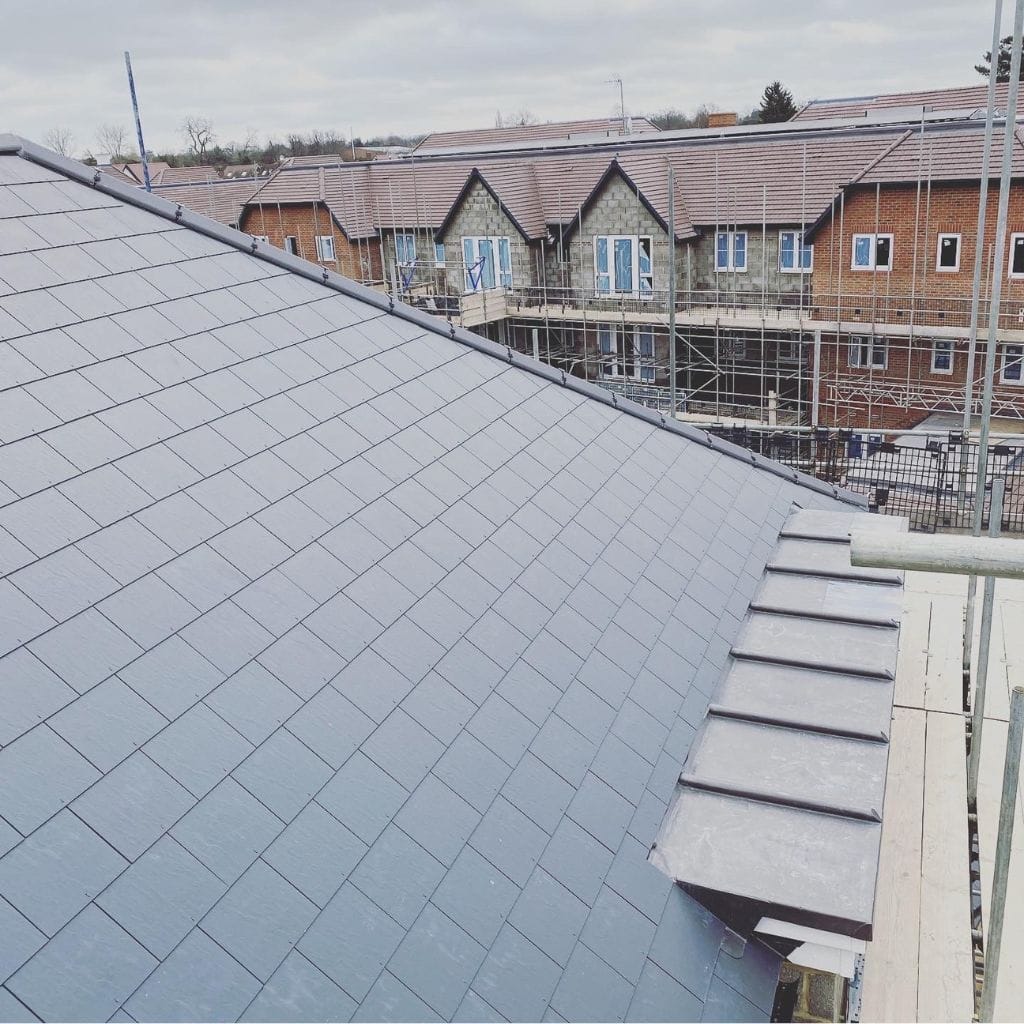
What does slating a Portsmouth roof involve?
Most of the slate removed from a roof returns to the slope, so the project is largely the sorting, stacking and re-hanging of the slate itself. This is how our team re-slates a Portsmouth roof, from the first survey through to the written record.
A director surveys the slate before anything is priced
The initial visit establishes which slate the elevation carries and how it was originally set out and lapped. A director additionally records the condition of the fixings, the battens and the rafters beneath. A roof inspection is the appropriate starting point where you need the existing roof assessed rather than renewed.
The quotation names the slate and what happens to the slate that comes off
Within 48 hours of the survey you receive an itemised quotation. It itemises the retained slate and the replacement slate separately, and the underlay, the battens, the lead and the ridge are priced alongside them. Labour and waste removal are listed on their own. There is no obligation and no hidden extras.
We strip the slate by hand and stack it on the scaffold
The team completes the stripping elevation by elevation and sorts the serviceable slate as it is removed, stacking it away from the working platform. The ground beneath the eaves is sheeted before anything is disturbed. The stacks stand clear of the driveway, so the household keeps the use of it throughout.
The elevation is set out before the first slate is hung
The team establishes the courses and the lap from the eaves, so the lines continue across the elevation and register correctly with the hips, the valleys, the verges and the abutments. Where the original slate returns to the slope, the setting out accommodates the sizes recovered from it.
Handover, the spare slate and the written record
The team clears the accumulated debris from the gutters and the valleys, and the surplus slate remains stacked wherever the household prefers. The record of the slate hung, and of the battens and underlay renewed beneath it, is issued with the invoice.
Why Choose Us for Slate Roofing in Portsmouth?
Over 15 years of experience working in Portsmouth
Connor and Jack bring over 15 years of combined hands-on roofing experience, delivering everything from small domestic repairs to large-scale commercial projects on Portsmouth's dense terraced streets, including new roof installation.

Local Portsmouth knowledge
Based in Portsmouth with deep local roots, we understand Hampshire's homes, weather and building styles, including the shared party walls of Portsmouth's slated terraces, which allows us to deliver roofing work that lasts.
5-star rated service
We are proud to be rated 5 stars on Google by our customers, reflecting the quality of our workmanship and our commitment to reliable, professional service.
Competent & highly trained team
Our team is fully trained and certified in asbestos awareness, working at height and manual handling, ensuring every project is carried out safely and to industry standards.
£5 million public liability insurance
We carry up to £5 million in public liability insurance, giving you complete peace of mind that your property is fully protected while we work in Portsmouth.
10 year workmanship guarantee
All new slate roof installations come with a 10-year workmanship guarantee, so you are covered in the unlikely event of any issues.







Frequently asked questions
Take a look at the Frequently Asked Questions regarding our Slate Roofing service in Portsmouth.
Can the slates from a Portsmouth roof be used again?
Yes, for the proportion that comes off sound, which on a roof that has not been coated or filleted is most of the elevation. The team sorts the slate on the scaffolding and reinstates it on new battens and fresh underlay, elevation by elevation. The shortfall is supplied from matching stock and itemised within the quotation. A director establishes that proportion at the survey. Where a single slate has slipped and the remainder of the slope is serviceable, a roof repair is the appropriate course.
Where does the slate go while a Portsmouth roof is stripped?
Slate that is to be reinstated remains on the property, stacked clear of the working area. The remainder is removed and the surrounding ground swept at completion. A slate installation requires standing room for the stacked slate in addition to the skip. On the city’s older terraced streets there is rarely a driveway and frequently no side return, so the stacked slate has nowhere to stand. The city’s later estates have driveways that take the stack alongside the skip. Where neither will fit, we confirm the arrangement with you in advance of the booking.
What happens if the weather turns while a Portsmouth roof is open?
Only the slope being worked is open at any point, and the team covers it before leaving the property. We sequence the stripping elevation by elevation rather than opening the entire roof, so the property never depends on a temporary covering across every slope. Slate already stacked is unaffected by rain, and the setting out resumes from the course the team had reached.
Are there Portsmouth roofs you would not re-slate?
Yes. Where the elevation or the rafters beneath will not carry slate, a director advises against it at survey and prices tile or an alternative covering instead. The same applies where the roof was never slated. Portsmouth’s council-built estates, raised across the city after the Second World War, were tiled from the outset, as were the estates added since. A change of material confers no appreciable benefit on those elevations. We recommend slate where the elevation was originally built with it.
What do you need from me to quote a Portsmouth slate roof?
A telephone call or the contact form, and access to the roof on the day of the survey. A director establishes what is on the roof, how it was originally set out and what lies immediately beneath it. The written, itemised quotation follows within 48 hours of that survey. You are under no obligation to proceed with the installation. We work to the same arrangement everywhere in our Portsmouth service area.
The Portsmouth Suburbs we Provide Slate Roofing services to:
Baffins, Buckland, Copnor, Cosham, Drayton, Eastney, Farlington, Fratton, Hilsea, Kingston, Landport, Milton, North End, Old Portsmouth, Paulsgrove, Portsea, Rudmore, Somerstown, Southsea, Stamshaw, Tipner, Wymering.
Our services in Portsmouth
Our Slate Roofing services near Portsmouth
About Portsmouth
Portsmouth
About PortsmouthPortsmouthCity & unitary authority areaPortsmouth Harbour, including Spinnaker TowerThe GuildhallSouthsea BeachHMS VictoryMary Rose MuseumGunwharf QuaysClarence PierFlagCoat of ArmsNickname: PompeyMotto: Heaven’s Light Our GuideShown within HampshirePortsmouthLocation within the United KingdomCoordinates: 50°48′21″N 01°05′14″W / 50.80583°N 1.08722°W Sovereign state United Kingdom Country England Region South East England Ceremonial county Hampshire Government • Type Unitary authority, city • Governing body Portsmouth City Council • Leadership Leader and Cabinet (Liberal Democrats) • Lord Mayor Abdul Kadir • Members of Parliament Stephen Morgan (L)
Amanda Martin (L)[2]Area • City & unitary authority area15.54 sq mi (40.25 km2) Population (2011, 2021)• City & unitary authority area208,100[1][a] • Urban 238,137[4][c] • Metro 855,679 (South Hampshire)[3][b] Ethnicity (2021) [5]• Ethnic groups List- 85.2% White
- 6.9% Asian
- 3.4% Black
- 2.6% Mixed
- 1.8% other
Religion (2021) [5]• Religion List- 47.1% no religion
- 39.4% Christianity
- 6.4% not stated
- 4.9% Islam
- 0.8% Hinduism
- 0.6% other
- 0.5% Buddhism
- 0.2% Sikhism
- 0.1% Judaism
Time zone UTC+0 (GMT) • Summer (DST) UTC+1 (BST) Postal code POArea code 023 ISO 3166 code GB-POR Police Hampshire and Isle of Wight Ambulance South Central Fire Hampshire and Isle of Wight Website portsmouth .gov .uk Portsmouth (/ˈpɔːrtsməθ/ ⓘ PORTS-məth) is a port city and unitary authority in Hampshire, England. Most of Portsmouth is located on Portsea Island, off the south coast of England in the Solent, making Portsmouth the only city in England not located primarily on the mainland. The city is located 22 miles (35 km) south-east of Southampton, 50 miles (80 km) west of Brighton and Hove and 74 miles (119 km) south-west of London. With a population last recorded at 208,100, it is the most densely populated city in the United Kingdom. Portsmouth forms part of the South Hampshire urban area with Gosport, Fareham, Havant, Eastleigh and Southampton.
Portsmouth’s history can be traced to Roman times and it has contained a significant Royal Navy dockyard and base for centuries. Portsmouth was founded c. 1180 by Anglo-Norman merchant Jean de Gisors in the south-west area of Portsea Island, a location now known as Old Portsmouth. Around this time, de Gisors ordered the construction of a chapel dedicated to St Thomas Becket. This became a parish church by the 14th century. Portsmouth was established as a town with a royal charter on 2 May 1194. The city is home to the first drydock ever built. It was constructed by Henry VII in 1496.
Portsmouth has the world’s oldest dry dock currently in use, “The Great Stone Dock”; originally built in 1698, rebuilt in 1769 and presently known as “No.5 Dock”. The world’s first mass production line was established at the naval base’s Block Mills which produced pulley blocks for the Royal Navy. By the early-19th century, Portsmouth was the most heavily fortified city in the world, and was considered “the world’s greatest naval port” at the height of the British Empire throughout Pax Britannica. By 1859, a ring of defensive land and sea forts, known as the Palmerston Forts, had been built around Portsmouth in anticipation of an invasion from continental Europe.
In the 20th century, Portsmouth achieved city status on 21 April 1926. During the Second World War, the city was bombed extensively in the Portsmouth Blitz, which resulted in the deaths of 930 people, and it was a pivotal embarkation point for the D-Day landings. In 1982, a British task force departed from Portsmouth to serve in the Falklands War. HMY Britannia was formerly based in Portsmouth and oversaw the transfer of Hong Kong in 1997, after which Britannia was retired from royal service, decommissioned and relocated to Leith as a museum ship.
Featured Business LocationC J Roofing & Renewables Ltd near Portsmouth
roofing contractor, service, establishment
5 stars (16 reviews)Phone: 023 9387 3756Nearby Suburbs