
Roof Replacement Portsmouth
Roof Replacement services in Portsmouth
A roof replacement renews every layer above the rafters and ends a cycle of recurring repairs. We install new battens, underlay and mechanical fixings across every slope simultaneously, to a single specification. The city’s Victorian and Edwardian terraces, post-war estates and Southsea’s Georgian and early-Victorian streets each carry a roof of a different generation. Every replacement is therefore specified against the individual building.
Every replacement begins with a free survey conducted by a director, who examines the loft interior and the slopes before the specification is set. The quote itemises the tiles or slates going back on, the fixings beneath them, and any timber renewal the strip-back is expected to expose. Your written, itemised quote follows within 48 hours of that survey, with no obligation to proceed. We respond within 48 hours.
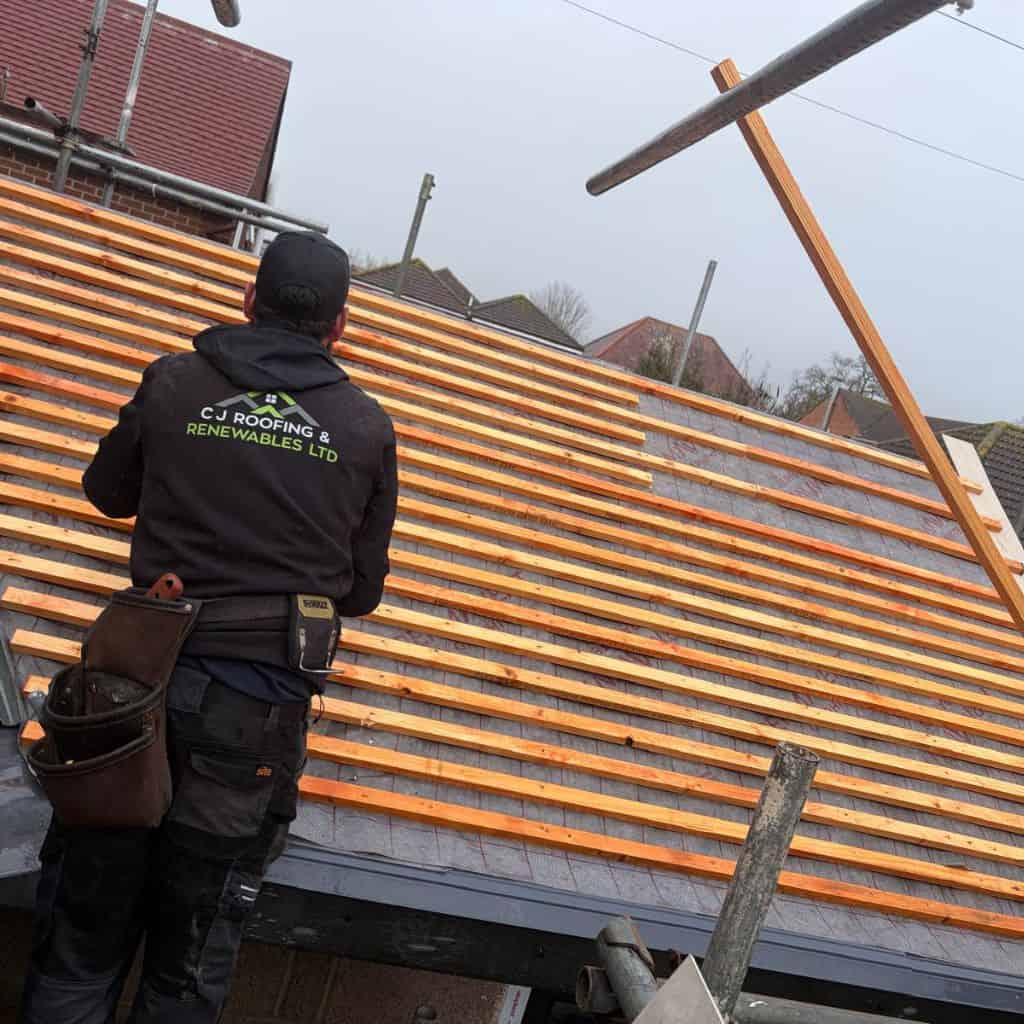
What do we most often find when replacing roofs in Portsmouth?
The condition of the battens, underlay and fixings is confirmed across the whole roof only once the tiles are removed. Portsmouth’s terraces run in long unbroken rows, so the battens and fixings along a roofline are usually one age and deteriorate together. What the strip-back most frequently reveals across the city includes:
Underlay perished beneath sound-looking tiles
The bitumen felt beneath most twentieth-century roofs becomes brittle earlier than the tiles above it, and tears at every lap, admitting water to the battens. A roof inspection from within the loft establishes its condition before any decision to strip and renew.
Across Portsmouth the post-war estates rebuilt after the city’s wartime bomb damage carry this generation of felt. The loft above each house in a run is inspected separately. Where the felt has perished, the battens beneath it are examined along their length.
Fixings crumbled in salt-laden air
On roofs near the coast the strip-back regularly shows nails and clips corroded to a stain in the timber, with the tiles above held only by their own weight. Stripping and refixing the covering restores the fixing across every course, in non-ferrous nails and clips.
Portsmouth sits on an island with open water on three sides, and its Victorian and Edwardian terraces have slate fixings old enough that this corrosion is common along a row. The new fixings stop at the party line.
Asbestos cement hidden in post-war details
Roofs from the post-war decades frequently incorporate asbestos cement in undercloaks, soffit boards or verge details, invisible until the tiles come off. Our team is trained to identify it, work stops around it, and a licensed contractor carries out the removal. The verge and soffit details are then rebuilt in new timber.
The prefab and council-built streets that replaced Portsmouth’s bombed housing fall inside that period. The verge and soffit details there are treated as suspect until the tiles are removed.
Valleys and junctions worn ahead of the slopes
Valleys and chimney junctions convey considerably more water than any part of a slope, so the boards and lead beneath them deteriorate first. Where the strip-back exposes decayed junction timbers, new boards and lead go in as the slopes around them are laid.
Portsmouth’s terraced houses share chimney stacks along the ridge, and the junctions around them have taken water since the row was built. New boards and lead are set in as each slope is relaid.
Deck timbers softened by decades of slow leaks
A leak too minor to stain a ceiling can saturate the same rafter or valley board for years. The deterioration is apparent only once the tiles come off, and replacement is the stage at which those timbers come out. Where a rafter has lost its strength, new timber is sistered alongside it before the battens are set out.
Portsmouth’s Victorian terraces are old enough for this to have happened more than once, and each rafter along a shared roofline is checked in turn.
How does Portsmouth housing shape a roof replacement?
Portsmouth is built almost entirely in continuous terraces, packed onto a low-lying island with little room between one roof and the next. A strip-back on one house exposes a structure shared with its neighbours: one continuous ridge, party walls and chimney stacks serving two houses at once. The terraces have no side access, so every batten, tile and fixing is carried up from the street at the front.
What goes back on has to sit flush with the roofs either side. Slate or clay tile is matched in dimension and colour so the new covering reads as one continuous roofline. Non-ferrous fixings and lead go in around every shared stack. On the post-war estates the tile profile is measured from the roof before the new covering is ordered. Scaffold and delivery access are agreed with the street in mind before work starts.
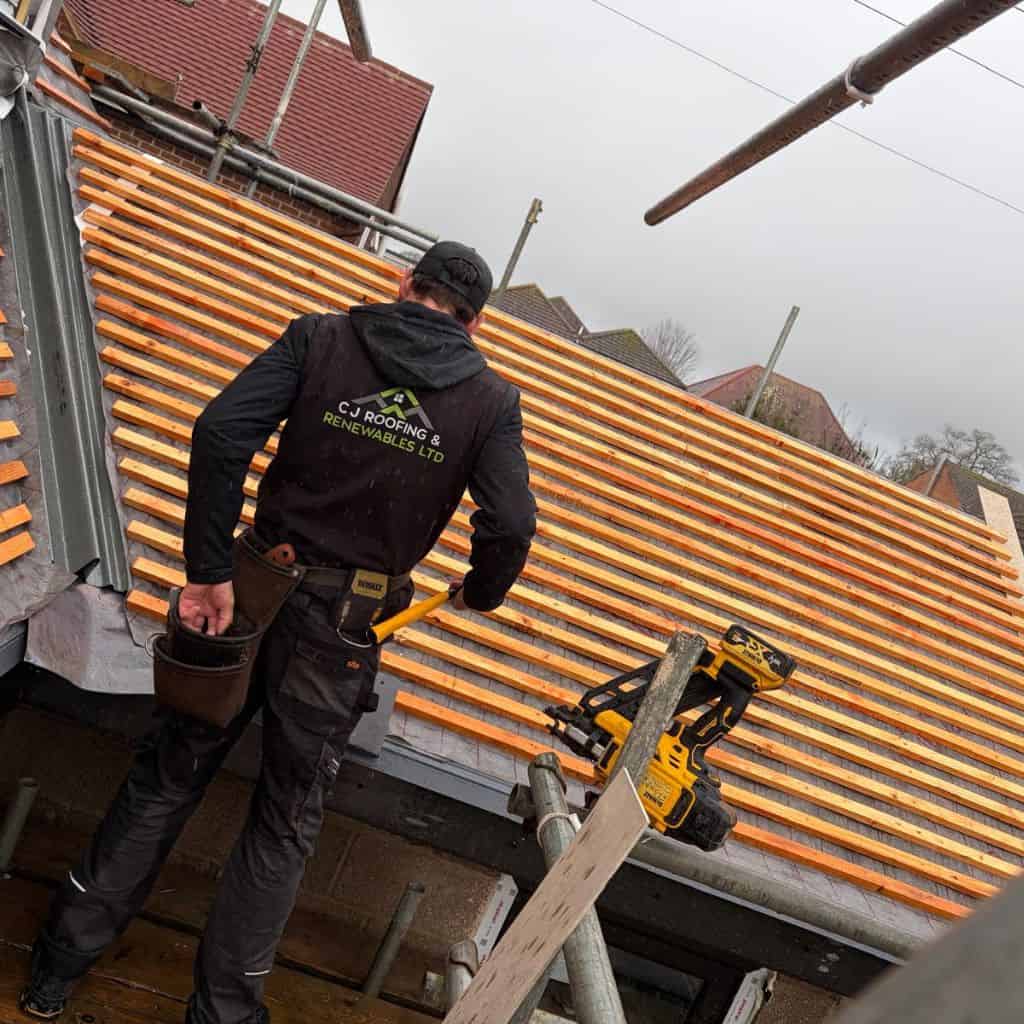
What does a roof replacement look like day to day in Portsmouth?
A scaffold, a skip and a working team arrive at your address for the duration. Each stage is scheduled around your household and the morning forecast, and in Portsmouth the sequence runs as follows:
The days before we start
The scaffold, the skip and the first deliveries of battens, underlay and tile arrive at times and locations agreed beforehand. You move garden furniture and vehicles clear of the working area before the first morning. Our team manages everything else on the schedule.
The pace of the strip
The morning forecast determines how many courses come off, and no more is stripped than new underlay and battens can close by evening. Any section not reached is left weathertight, so the loft and the ceilings beneath it are protected overnight.
Pricing what the strip uncovers
If the strip-back uncovers a rafter, purlin or flashing detail beyond the quote, work there stops until you have seen it and agreed the price. A written note records any further work before it proceeds. No item appears on the final invoice without your approval.
New underlay, battens and tiles in sequence
Underlay, battens, flashings and the new tiles go on in that order, each course lapping the one beneath. Whether the specification is tile roofing or natural slate, each slope is completed and its ridge and verge detailed before the next is started.
The last day
A director walks you round the finished roof from ground level and hands over the written documentation for the work. Our team removes the waste and clears the new gutters, and the scaffold is booked off site once the final check is signed.
Why Choose Us for Roof Replacement in Portsmouth?
Over 15 years of experience working in Portsmouth
Connor and Jack bring over 15 years of combined hands-on roofing experience, delivering everything from small domestic repairs to large-scale commercial projects, including roof replacements on Portsmouth's continuous terraced roofs.

Local Portsmouth knowledge
Based in Portsmouth with deep local roots, we understand Hampshire's homes, weather and building styles, including the shared roofline a Portsmouth terrace strip-back exposes, which allows us to deliver roofing work that lasts.
5-star rated service
We are proud to be rated 5 stars on Google by our customers, reflecting the quality of our workmanship and our commitment to reliable, professional service.
Competent & highly trained team
Our team is fully trained and certified in asbestos awareness, working at height and manual handling, ensuring every project is carried out safely and to industry standards.
£5 million public liability insurance
We carry up to £5 million in public liability insurance, giving you complete peace of mind that your property is fully protected while we work in Portsmouth.
10 year workmanship guarantee
All new roof installations and replacements come with a 10-year workmanship guarantee, so you are covered in the unlikely event of any issues, and a roof repair is quoted where a Portsmouth roof remains sound.







Frequently asked questions
Take a look at the Frequently Asked Questions regarding our Roof Replacement service in Portsmouth.
How much does it cost to replace a roof in Portsmouth?
Four factors determine the cost of a replacement:
- The quantity of tile and batten removed, and its disposal
- Any rafter or batten renewal the strip-back proves necessary
- The dimensions, pitch and complexity of the slopes
- The tiles or slates going back on, over new underlay and fixings
A free survey conducted by a director establishes all four, and your written, itemised quote follows within 48 hours of it, with every item priced and no hidden extras.
Will a replacement roof match the rest of your Portsmouth street?
Yes, and the match is specified at survey. Portsmouth’s Victorian and Edwardian terraces were roofed mainly in slate and clay tile, and the post-war estates carry concrete interlocking tile instead. A replacement on either matches like for like. Slate roofing goes back in the same dimension and colour, or clay tile to the original gauge and ridge detail. New slate sits brighter than weathered slate beside it, so we show you a sample against the row before ordering.
Do you need planning permission to replace a roof in Portsmouth?
In most cases, no. Where the new roof is similar in appearance to the one it replaces, a like-for-like replacement is normally permitted development and no application is necessary. A listed building is the exception, and consent is required before the covering or the chimney stack details change. Controls in a conservation area differ from one designation to the next, and a change of covering can require consent. We establish which applies at survey, and the quote accounts for it before any work begins.
Is it worth replacing the roof on an older Portsmouth home?
On an older property it generally is. Portsmouth’s Victorian and Edwardian terraces carry roofs at the age where individual repairs begin to recur. A replacement adds the layers absent from a roof of that generation, including a breathable roof underlay, mechanically fixed tiles and a ventilated ridge. The fixings then meet current standards across every slope, and the loft has a ventilation path.
How do I arrange a roof replacement quote in Portsmouth?
Contact us by telephone or through the enquiry form on this website. The free survey is conducted by a director at a time convenient to you, covering the eaves, flashings and loft interior. If the roof retains serviceable life, we recommend a repair and quote for that instead. Otherwise your written, itemised quote for the replacement follows within 48 hours of the visit. We cover the whole of our Portsmouth service area.
The Portsmouth Suburbs we Provide Roof Replacement services to:
Baffins, Buckland, Copnor, Cosham, Drayton, Eastney, Farlington, Fratton, Hilsea, Kingston, Landport, Milton, North End, Old Portsmouth, Paulsgrove, Portsea, Rudmore, Somerstown, Southsea, Stamshaw, Tipner, Wymering.
Our services in Portsmouth
Our Roof Replacement services near Portsmouth
About Portsmouth
Portsmouth
About PortsmouthPortsmouthCity & unitary authority areaPortsmouth Harbour, including Spinnaker TowerThe GuildhallSouthsea BeachHMS VictoryMary Rose MuseumGunwharf QuaysClarence PierFlagCoat of ArmsNickname: PompeyMotto: Heaven’s Light Our GuideShown within HampshirePortsmouthLocation within the United KingdomCoordinates: 50°48′21″N 01°05′14″W / 50.80583°N 1.08722°W Sovereign state United Kingdom Country England Region South East England Ceremonial county Hampshire Government • Type Unitary authority, city • Governing body Portsmouth City Council • Leadership Leader and Cabinet (Liberal Democrats) • Lord Mayor Abdul Kadir • Members of Parliament Stephen Morgan (L)
Amanda Martin (L)[2]Area • City & unitary authority area15.54 sq mi (40.25 km2) Population (2011, 2021)• City & unitary authority area208,100[1][a] • Urban 238,137[4][c] • Metro 855,679 (South Hampshire)[3][b] Ethnicity (2021) [5]• Ethnic groups List- 85.2% White
- 6.9% Asian
- 3.4% Black
- 2.6% Mixed
- 1.8% other
Religion (2021) [5]• Religion List- 47.1% no religion
- 39.4% Christianity
- 6.4% not stated
- 4.9% Islam
- 0.8% Hinduism
- 0.6% other
- 0.5% Buddhism
- 0.2% Sikhism
- 0.1% Judaism
Time zone UTC+0 (GMT) • Summer (DST) UTC+1 (BST) Postal code POArea code 023 ISO 3166 code GB-POR Police Hampshire and Isle of Wight Ambulance South Central Fire Hampshire and Isle of Wight Website portsmouth .gov .uk Portsmouth (/ˈpɔːrtsməθ/ ⓘ PORTS-məth) is a port city and unitary authority in Hampshire, England. Most of Portsmouth is located on Portsea Island, off the south coast of England in the Solent, making Portsmouth the only city in England not located primarily on the mainland. The city is located 22 miles (35 km) south-east of Southampton, 50 miles (80 km) west of Brighton and Hove and 74 miles (119 km) south-west of London. With a population last recorded at 208,100, it is the most densely populated city in the United Kingdom. Portsmouth forms part of the South Hampshire urban area with Gosport, Fareham, Havant, Eastleigh and Southampton.
Portsmouth’s history can be traced to Roman times and it has contained a significant Royal Navy dockyard and base for centuries. Portsmouth was founded c. 1180 by Anglo-Norman merchant Jean de Gisors in the south-west area of Portsea Island, a location now known as Old Portsmouth. Around this time, de Gisors ordered the construction of a chapel dedicated to St Thomas Becket. This became a parish church by the 14th century. Portsmouth was established as a town with a royal charter on 2 May 1194. The city is home to the first drydock ever built. It was constructed by Henry VII in 1496.
Portsmouth has the world’s oldest dry dock currently in use, “The Great Stone Dock”; originally built in 1698, rebuilt in 1769 and presently known as “No.5 Dock”. The world’s first mass production line was established at the naval base’s Block Mills which produced pulley blocks for the Royal Navy. By the early-19th century, Portsmouth was the most heavily fortified city in the world, and was considered “the world’s greatest naval port” at the height of the British Empire throughout Pax Britannica. By 1859, a ring of defensive land and sea forts, known as the Palmerston Forts, had been built around Portsmouth in anticipation of an invasion from continental Europe.
In the 20th century, Portsmouth achieved city status on 21 April 1926. During the Second World War, the city was bombed extensively in the Portsmouth Blitz, which resulted in the deaths of 930 people, and it was a pivotal embarkation point for the D-Day landings. In 1982, a British task force departed from Portsmouth to serve in the Falklands War. HMY Britannia was formerly based in Portsmouth and oversaw the transfer of Hong Kong in 1997, after which Britannia was retired from royal service, decommissioned and relocated to Leith as a museum ship.
Featured Business LocationC J Roofing & Renewables Ltd near Portsmouth
roofing contractor, service, establishment
5 stars (16 reviews)Phone: 023 9387 3756Nearby Suburbs